![[personal profile]](https://www.dreamwidth.org/img/silk/identity/user.png) defrog
defrogWhich wasn't all that fast this month, and you can blame the first of these entries if you want to. Yeah. If you want to.
 The Name of the Rose by Umberto Eco
My rating: 3 of 5 stars
I’ve never read Umberto Eco before – a fact that, sadly, I didn’t think much about until he passed away recently. This is his first and probably most famous novel, and while it seemed like too obvious a starting point, several people recommended it as the best possible intro to his work. If you don’t know, the basic framework is a murder mystery set in a remote Italian monastery in the 12th Century – Brother William and his apprentice Adso arrive to attend a theological disputation between competing sects. As William – a former Inquisitor – is good at investigations, the abbot asks him to look into the mysterious death of a monk as long as he’s there. When bodies start piling up, William finds that a common denominator seems to be the monastery’s famed library. The mystery is partly a vehicle for Eco to explore a lot of philosophical and religious arguments at length – which I would normally welcome, but Eco tends to pile it on to the point of overwhelming the narrative. Then again, I'll admit I’m probably not smart enough to appreciate the depth of what Eco is doing here (the novel has been hailed as a classic work of postmodern semiotics, whatever that means). I will say that some of the arguments are interesting, and the mystery itself is well crafted. And despite a rather melodramatic climax, Eco offers an unconventional solution. It’s also a masterclass of historical worldbuilding. I can’t say it made me a fan – as good as it is, it’s more work than I really want a book to be in my old age – but I do have a collection of some of his essays in the queue, so I’ll be trying Eco again.
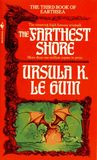 The Farthest Shore by Ursula K. Le Guin
My rating: 4 of 5 stars
This is the third book of the Earthsea Cycle, and the last of the original trilogy of books, both of which I enjoyed despite not being the fan of fantasy that I used to be. This one essentially wraps up the saga of the wizard Sparrowhawk a.k.a. Ged, who is now middle-aged and Archmage. Arren, the prince of Enlad, comes to him to report rumors from the South that magic is disappearing from the world. Sparrowhawk decides to travel to investigate, and takes Arren with him. Similar to the previous two books, it’s a coming-of-age story – in this case for Arren, who is in awe of Sparrowhawk and comes to learn about himself as well as his hero, not all of it pleasant. So in a sense Arren is the main protagonist here – and yet Sparrowhawk is still a strong presence as the journey offers a sense of closure for his past transgressions – he is older and wiser but by no means invincible, which is one of the main themes of the story. For some reason this one resonated more than the first two – maybe it’s because it took the first two books to really warm up to the series. I also like how Le Guin handles the idea of a magic world where the magic is fading away. A satisfying conclusion.
View all my reviews
Magic man,
This is dF
The Name of the Rose by Umberto EcoMy rating: 3 of 5 stars
I’ve never read Umberto Eco before – a fact that, sadly, I didn’t think much about until he passed away recently. This is his first and probably most famous novel, and while it seemed like too obvious a starting point, several people recommended it as the best possible intro to his work. If you don’t know, the basic framework is a murder mystery set in a remote Italian monastery in the 12th Century – Brother William and his apprentice Adso arrive to attend a theological disputation between competing sects. As William – a former Inquisitor – is good at investigations, the abbot asks him to look into the mysterious death of a monk as long as he’s there. When bodies start piling up, William finds that a common denominator seems to be the monastery’s famed library. The mystery is partly a vehicle for Eco to explore a lot of philosophical and religious arguments at length – which I would normally welcome, but Eco tends to pile it on to the point of overwhelming the narrative. Then again, I'll admit I’m probably not smart enough to appreciate the depth of what Eco is doing here (the novel has been hailed as a classic work of postmodern semiotics, whatever that means). I will say that some of the arguments are interesting, and the mystery itself is well crafted. And despite a rather melodramatic climax, Eco offers an unconventional solution. It’s also a masterclass of historical worldbuilding. I can’t say it made me a fan – as good as it is, it’s more work than I really want a book to be in my old age – but I do have a collection of some of his essays in the queue, so I’ll be trying Eco again.
The Farthest Shore by Ursula K. Le GuinMy rating: 4 of 5 stars
This is the third book of the Earthsea Cycle, and the last of the original trilogy of books, both of which I enjoyed despite not being the fan of fantasy that I used to be. This one essentially wraps up the saga of the wizard Sparrowhawk a.k.a. Ged, who is now middle-aged and Archmage. Arren, the prince of Enlad, comes to him to report rumors from the South that magic is disappearing from the world. Sparrowhawk decides to travel to investigate, and takes Arren with him. Similar to the previous two books, it’s a coming-of-age story – in this case for Arren, who is in awe of Sparrowhawk and comes to learn about himself as well as his hero, not all of it pleasant. So in a sense Arren is the main protagonist here – and yet Sparrowhawk is still a strong presence as the journey offers a sense of closure for his past transgressions – he is older and wiser but by no means invincible, which is one of the main themes of the story. For some reason this one resonated more than the first two – maybe it’s because it took the first two books to really warm up to the series. I also like how Le Guin handles the idea of a magic world where the magic is fading away. A satisfying conclusion.
View all my reviews
Magic man,
This is dF
