defrog: (Default)

The Hong Kong Special Administrative Region turned 25 yesterday.

Chief executive Carrie Lam, who “decided” not to seek another term, is gone.

Replacing her is John Lee, a former cop who (as Secretary of Security) led the hardcore crackdown on the 2019 protests. He was personally selected by the CCP as their preferred candidate, and he ran unopposed in what we laughably call an “election” (in which the Election Committee – 1,461 elites vetted by Lee himself and approved by Beijing – are the only voters allowed – Lee won 99.4% of the vote, and the 0.6% are probably under investigation by now).


So you have an idea of how the next 25 years are going to go. To clarify, Lee’s term is only five years (and he can run for re-election, though that’s a rare thing in HK), but it’s a fair bet that Lee’s successors will run with whatever ball they’re handed – because it is after all Beijing’s ball, and that’s the nature of the gig.


Do I have thoughts? I do, though there’s too much to say and at the same time nothing much to say.


1. It’s probably worth starting with sharing some links, like where HK is now in terms of the national security law, press freedom, civil society, and in general. On the whole, it’s not good. Unless you happen to share the views of GovHK and the CCP (or accept their highly idiosyncratic definitions of One Country Two Systems, free speech, press freedom, universal suffrage, judicial indepencdence, etc –  in which case, yr probably enjoying yourself.


2. Here’s another link explaining how we got here – and it’s worth reading as a cautionary tale for other countries who are experiencing creeping authoritarianism right now. Simply put, it’s not an overnight thing – it’s a long game, years in the making. And you'd be surprised how many people will accept it as long as it works in their favor. 


3. Here’s a link reviewing Carrie Lam’s legacy and her role in taking a wrecking ball to HK’s freedoms, and her Beijing-directed zero-COVID policies that have decimated the economy.


4. And here’s one about John Lee and what we can expect from him.


5. The HKSAR 25th Anniversary itself was somehow a perfect metaphor for where we are right now – the convention centre walled off for blocks around, most media banned from attending it (though they could cover it using govt-supplied video), and a typhoon poised to shut down the rest of the city. No fireworks, no gala event, no party, just lots and lots of Chinese flags everywhere. China President Xi Jinping came down to swear in Lee and make a big speech about HK’s prosperous future now that it’s been brought to heel and the pro-democracy camp in jail or in exile. Good times.


6. And so, what now? Likely more of the same, only more so – an expansion of the national security law to cover even more vaguely defined offenses against the state, a “fake news” law that is very likely to be used to keep the media in line and crack down on social media, the June 4 candlelight vigil permanently bannedbook bans, and of course the usual official gaslighting: Hong Kong has lost none of its freedoms, the protests were funded and run by foreign forces out to overthrow China, HK was never a British colony, etc. To say nothing of the continued and accelerated blurring of boundaries as Hong Kong gets co-opted into the Greater Bay Area project.


Which is a drag, of course.


7. To answer the inevitable question (and one which now regularly appears when meeting local people I haven’t talked to for awhile) – “Are you planning to leave HK?” – the answer is: no. Not right now. I’ve lived here 26 years now, longer than I’ve lived anywhere else, so this is home. The one thing that would convince us to go back to the US is if my mom (who is 90, bless her) needs more looking after than my sister can provide on her own.


But apart from that, the political aspects don’t affect me too much right now. Perhaps they will later, especially with US-China relations deteriorating. I don’t feel in any real danger of being arrested, if only because GovHK isn’t interested in jailing literally everyone who says bad things about them – and that’s mainly because it’s logistically impossible. They know full well how much support the pro-Demo movement and the protesters had then (and have now). It scares them. So they’re hoping to make enough public examples of the high-profile ringleaders who have actual influence to encourage the rest of us to shut up.


My social media presence is modest and my follower numbers meagre. I think I’ll be fine. Perhaps that’s naïve. We’ll see.


Staying put,


This is dF

defrog: (Default)
Today marks the 26th anniversary of my arrival in Hong Kong. 

How it started / how it's going


But seriously. 

I don't have time to do a proper post, but suffice to say that between the slide into an authoritarian state and our Zero COVID strategy – and all of that in the last three years – HK is a much different place than it was when I got here. 

The COVID situation here is especially stressful – NBC News explains why here but essentially we went from 12,000 cases and 213 deaths in the first week of February 2022 (which took us two years to accumulate) to 1,047,690 cases and 5,896 deaths as of today. 

All that in just six weeks. And mainly because HK had no strategy apart from "don't let the COVID in", which is the strategy Beijing told us to adopt because that's what they're doing. Maybe the govt thought having a fallback plan would be an insult to Beijing's wisdom? 

Anyway, here we are.

The good news: The fifth COVID wave is subsiding. The bad news: the national security crackdown is poised to get much worse. For all of Carrie Lam's efforts in the past couple of years, we're still relatively more free compared to China. And you can bet your bottom dollar Xi Jinping wants to fix that, as does our current security chief, who hates us and will jail as many of us as it takes to shut us up and love Xi Jinping as much as he does.

On the bright side, I'm still married and we'll be celebrating 25 years next week. So there's that.

Developing ...

Tales from the dark side, 

This is dF


defrog: (books)

PRODUCTION NOTE: I wrote a version of this post back in 2008, inspired by this post by John Mark Ockerbloom, a digital library architect and planner at the University of Pennsylvania, on why it matters that we have a Banned Books Week.

And given current events, it seems prudent to update it. –Ed.

As you know, the GOP has been on a book-banning spree, and not just for the usual rationales (i.e. fear of naughty words, nipples and gay people, although these are still very much in play). Now it’s all about getting rid of books that teach that fascism and racism are bad, on the apparent fear that these books will make white people feel guilty about supporting either. Or something.


Anyway, nothing says “we’re not Nazis” than holding a book burning event, right?


The good news is that while efforts to ban books are on the rise, it’s still not as widespread as social media makes it look. At least not right now.


Also, at least some kids aren’t having it, and are going as far as to form Banned Book Clubs to read these books that Republicans are telling them they shouldn’t be reading. And various groups have been buying and sending copies of banned books to people who live in states where they’re being removed from libraries. Meanwhile, Art Spiegelman is going to see a boost in his royalty cheques thanks to the McMinn County School Board.

So, great.


However, this is usually where the GOP and their apologists like to claim that they’re not banning books because all of these books are still for sale and easily accessible via Amazon or whatever booksellers are still left. So all of the dithering over book banning is liberal schadenfreude propaganda to cancel Republicans, etc.


By perhaps no coincidence, this is the same argument that many of the same people use to justify defunding libraries completely in the name of fiscal responsibility. If you can’t ban books, you can at least close the libraries. And again, they say, there’s always Amazon et al.


In both cases, the “there’s always Amazon” argument represents a fundamental misunderstanding of what libraries are for. Neil Gaiman makes a better case for libraries here than I ever will, and part of it covers why forcing libraries to remove books to protect children is not only a bad idea, but unnecessary.


In short, a primary function of libraries is to foster a love of reading in kids. Not everyone can afford to buy books whenever they want to read one. Libraries ensure every kid can benefit from books, and that people of all ages have equal access to whatever books or other useful information and services libraries offer. And in order for this to work, libraries must be free to offer books that matter to readers of all ages.


Yes, libraries have to make editorial decisions because of limited budgets and shelf space. And yes, patrons of schools and libraries should have the freedom to question those decisions. But as Ockerbloom points out here:


… There’s a world of difference between saying “isn’t this more appropriate for the YA shelves than for the early readers section?” or “Would this title be a better fourth-grade book on this topic than the one currently being used?”, and insisting “None of our kids should be reading about this kind of thing!” when “this kind of thing” is already on the minds of those kids, or something that they should be thinking about.


This is the thing about library book bans – they ensure no one of any age can have access to it. The “just buy it on Amazon” meme is simply arguing that free speech should only be available to those who can pay for it. And again, it’s also beside the point. To paraphrase Ockerbloom, freedom of speech isn’t just about the freedom to write what matters to you, but also the freedom to read what matters to you: “An unread book, after all, has as little impact as an unpublished book.”


Meanwhile, it’s also worth pointing out that while none of this is really new, the current book ban trend is more insidious than the usual handwringing.


Apart from being more coordinated across various states, it’s also happening within the broader context of the current and broader white conservative mindset that they are losing the Great American Culture War against the Evil Gay Black Liberal Communist LGBTQA-CRT Horde, and the only way they can win now (and save America) is to take control of schools and universities – not just with book bans, but also with legislation that censors teachers and restructures curricula along right-wing ideological lines to ensure students are taught their ideology, which will also teach them how to view everyone else’s ideologies.


Which of course is a direct contradiction to the GOP’s stated opposition to Big Govt and Cancel Culture. Also, as a resident of Hong Kong – where book bans and control of education is very much a pillar of Beijing’s current effort to stamp out all dissent and turn us all into unquestioning CCP patriots whether we like it or not – I also find it grimly ironic that the GOP delights in criticizing China for what it’s doing to HK whilst simultaneously trying to employ similar tactics in America.


But if Trump taught us anything, it’s that authoritarianism doesn't have to be consistent, or even make sense – it just has to appear to empower you and your tribe at the expense of everyone you hate.


Anyway, book bans are silly, is what I’m saying.


Read me like a book,


This is dF

defrog: (Default)

You know by now that Neil Young has started an exodus of sorts from Spotify over Joe Rogan’s podcasts. It’s not a long list of artists right now, but it seems to be getting longer, so it will be interesting to see how far this escalates. And as someone who uses Spotify mainly because of a lack of viable alternatives in HK (before you ask, no we don’t get Pandora or SiriusXM here), I have a few thoughts about it.


1. To get the obvious stuff out of the way, I don’t listen to Joe Rogan – in fact I didn’t really know anything about him until this whole thing erupted. I mention this because most of the online “debate” seems to depend exclusively on one’s pre-established opinion of Rogan, Neil Young or Spotify, so I’m coming from a more nuanced position here.


2. Not unexpectedly, Spotify has defaulted to the free-speech defense, saying that as a content platform it doesn’t want to be in the position of censoring people. Which is admirable, except that we have already gone through this whole argument with Facebook and Twitter’s moderation policies: Facebook vs Alex Jones, Twitter vs Donald Trump, YouTube vs PewDiePie, etc.


Like any other platform, Spotify does have user T&Cs that give it the right to boot anyone who violates them, and considering the regulatory heat that Facebook, Twitter and Google has been enduring over their unwillingness to police extremist content that generates likes, retweets and other things that keep the advertisers happy – and the demonstrable real-world consequences of this – you’d think Daniel Ek would read the room a little better.


3. On the other hand, as others have pointed out, a key difference between Facebook, Twitter and Spotify is that only of these companies signed a $100 million multi-year contract with Rogan for exclusive rights to host his podcasts, and has spent close to $1 billion on acquisitions to beef up its podcast library. Spotify’s profit margin for music isn't that great because most of what it earns has to be paid back out in royalties (and remember, Spotify’s royalty calculations are infamously non-generous to begin with). So it needs other ways to make money – it’s banking on podcasts for that, and Rogan is one of the most popular podcasts on its platform. All of which makes it a lot more difficult for Spotify to simply boot Rogan the same way that Trump, Jones and PewDiePie eventually got shown the door.


4. Spotify’s decision to make its content moderation guidelines public and put COVID information links on Rogan’s podcast (which Rogan has said he’s fine with) may or may not be a an effective solution, though at the very least it’s a good start. Personally I’m not convinced that kicking Rogan off Spotify would solve anything. On the other hand, I do think Spotify needs to take its own moderation policies more seriously and hold its talent accountable – especially at a time when people are actively weaponizing social media platforms to spread disinformation, and when COVID disinformation in particular is contributing to the spread of a deadly pandemic.


5. Whether that means Neil, Joni et al will put their music back on Spotify is really up to Neil, Joni et al. Honestly, as far as I’m concerned, Neil and Joni can put their music anywhere they want, and they can pick and choose which platforms to use for any reason they like. It’s their music, and if they don’t want to be on the same platform as Rogan, who am I to be critical?


Deplatformed,


This is dF

defrog: (Default)

ITEM: Hong Kong has a new and improved election system that – we are assured – will result in more democracy than we’ve ever had before.


Here’s how RTHK put it on Twitter:


Which is about right.


To explain: the “reforms” were imposed on us by Beijing in response to the 2019 protests, the landslide victory of pro-Democracy candidates in the District Council elections at the end of that year, and the pro-Demo primary in 2020 that was part of their planned strategy to win a majority in LegCo for the first time in the LegCo elections in September that year.


Every single person who ran in that primary is now in jail for violating China’s national security. (No, really.)


Meanwhile, as there was a pretty good chance the pro-Demo strategy actually might have actually worked, the HK govt postponed the LegCo election for a year (citing COVID-19 as the official reason, of course), and Beijing decided our election system and our democracy in general needed fixing.


Well, they fixed it all right.


The details are here if you want them, but in the name of TL;DR, here’s an analogy:


Imagine that Congress had a total of 70 seats, only half of which (35) are directly elected by the people. The other half are elected by business sectors and special interests.


Imagine also that the POTUS (let’s say Trump, for example) is elected not by regular voters but an Electoral Committee of 1,200 electors controlled by the GOP, which gets final approval on who serves on the committee. The same committee also gets to decide who gets to run for POTUS.


That was our system until today.


Here’s the new system:

  • Congress will be expanded to 90 seats, but you can only vote for 20 of them
  • Of the remainder, 30 will be elected by business reps and the other 40 will be elected by the same Electoral Committee that elects the POTUS
  • That committee (which is now 1,500 people, 1,000 of which are hand-picked and appointed by the GOP, the rest elected by approved pro-GOP corporations and interest groups) also gets final say on who gets to run for all 90 Congressional seats
  • A new committee will vet all candidates to ensure they are “patriots”. They will be assisted by the national security police to make sure the candidates are not national security threats.
  • Any candidate disqualified by the committee is subject to arrest by the national security police for violating the national security law
  • Encouraging people to cast protest votes in any way shape or form (to include t-shirt slogans) is punishable by three years in prison, even though protest votes are not illegal.

 So, yes. That’s our democracy now.


CAVEAT: It’s an imperfect analogy in the sense that the HK isn’t a two party system. Rather, we have a number of parties divided into two ideological camps – pro-Beijing and pro-Democracy. The CCP does not operate as a political party in HK, but from this point on, only candidates (regardless of political party) who pledge patriotic loyalty to China and the CCP can run for office – which basically means anyone approved by the CCP to run for office in HK is by default CCP-adjacent, if not literally a party member.


Naturally, Carrie Lam and whatever LegCo members are left (as most pro-Democrat politicians are either disqualified, in jail or in exile) are selling it as a delightful, major improvement that it actually makes Hong Kong more democratic, because it ensures that all voices are represented. (To explain: Beijing’s idea of “representation” is that all points of view are welcome to be represented in government, so long as only pro-Beijing voices have majority control forever – and as long as all views come with a pledge of loyalty to the CCP.)


They’re also selling this in the TV PSAs as a matter of national security with a direct link to the 2019 protests. Essentially, this involves a rewrite of history that combines two separate elements – protest violence + rowdy scenes in LegCo by pan-Democrats with a penchant for theatre – as if all of this was one big violent separatist movement funded by Western govts to create anarchy, take over the govt and overthrow Beijing.


“See? It’s either this or TOTAL VIOLENT CHAOS! Which would you rather have?”


Which of course is 100% false. But this is the same govt that arrested 53 pro-Demos for attempting to legally win a LegCo majority and tells teenagers holding up blank placards in malls that they’re violating national security. So.


BONUS TRACK: Regarding the RTHK tweet, here’s a link about how RTHK (our local public broadcaster) is being slowly but surely transformed from the best and most trusted news source in the city to a govt propaganda mill. Their social media person (at least on the English language side) is apparently keen on going down swinging.


Voted off the island,


This is dF

defrog: (life is offensive)

Fox News is flipping out over Dr Seuss and Neanderthals. Because those are the REAL problems facing America.


The Neanderthal thing is of course silly. And, you know, so is the Dr Seuss thing, but it’s the more bloggable of the two, since it involves books, censorship and the whole cancel culture “debate”.


So:


1. Let’s start with the acknowledgment that “cancel culture” is already a politically loaded (and thus meaningless) term. Conservatives use it the same way they use the term “political correctness”: a catch-all defense for racist/sexist/homophobic behavior in the name of some vague freedom to do and say anything you want with no social consequences whatsoever.


2. Whatever you think “cancel culture” is, the Dr Seuss saga hardly qualifies. For one thing, Dr Seuss Enterprises (i.e. the organization that controls the copyrights of Geisel’s works) made the decision on their own to stop printing six books. No one pressured them to do so. And they’re also fine with the decision to decouple Reading Across America from Dr Seuss books – which I am also fine with because believe it or not, there are plenty of great children’s books out there that are not written Dr Seuss, so why focus on just one author?


3. Also, as has been pointed out, no librarians (as far as I know) are pulling Dr Seuss books from library shelves – not even the six that will be discontinued. 


4. We also have to acknowledge the elephant in the room: Geisel did use racist stereotypes in his work. Not all of it – most of it can be found in his WW2 propaganda cartoons, which were both decidedly anti-fascist and horribly racist in terms of depicting Asians. Of course, most of his books don’t contain racist stereotypes, so there’s that. And sure, you can find a number of ethnic people who aren’t offended by those images and take it in stride as the embedded racism of the times. But some are. And anyway, there’s a bigger point here: America can’t get past its racism problem until it admits that it has one, and that this problem didn’t spring up out of nowhere but is arguably by design. That includes acknowledging that books like the Seuss Six have racist stereotypes in them.


5. Which is why, for me, all of this is the latest instalment in the ongoing debate of how we should be looking at racist pop culture in the modern world. In a way, it’s also part of the adjacent discussion of whether art created by racists, sexists, homophobes, misogynists and other awful people should still be acknowledged as part of legitimate pop culture. (Or to put it another way, can I still like Woody Allen movies or Roald Dahl books with a clear conscience?)


The general worry is that once we brand a particular book, film or song as racist/sexist/homophobic, it will be deleted from the pop-culture canon (either literally or through people refusing to consume it). Which does present a paradox of sorts: can we acknowledge our racist past whilst simultaneously deleting or omitting pop-culture evidence of that past? At the same time, should a society that values free speech be deleting or omitting ideas it finds offensive?


As I say, it’s an old debate. Personally, I like the approach of Warner Brothers, which owns the Looney Tunes cartoons, as well as Tom & Jerry. Both series include cartoons using racist stereotypes, and the studio had to decide whether to censor those scenes or keep them intact for home video releases. They decided to leave them uncensored but include a pre-roll disclaimer (first as a slide, later as a Whoopi Goldberg intro) that says this:


The cartoons you are about to see are products of their time. They may depict some of the ethnic and racial prejudices that were commonplace in the U.S society. These depictions were wrong then and they are wrong today. While the following does not represent the Warner Bros. view of today's society, these cartoons are being presented as they were originally created, because to do otherwise would be the same as claiming that these prejudices never existed. [Italics mine]


(Disney+ is doing something similar, though they're arguably doing it a bit too quietly.)


Maybe Dr Seuss Enterprises might consider a similar approach for the Seuss Six.


Not that it would make the Fox News heads any less calm. But then they're paid to be indignantly outraged over this stuff.


The doctor is in,


This is dF

defrog: (Default)

Given how hard Hong Kong’s pro-democracy activists have been fighting to establish true democracy in Hong Kong, you’d think they’d also be happy at the news that the US has managed to survive Donald Trump’s attempt to destroy democracy there, and that Trump has been denied a second term.


And you’d be not entirely correct.


Some pro-Democracy activists in HK (not all, but a lot) are disappointed in Biden’s victory, and up to Election Day were hoping out loud that Trump would win re-election.


If that sounds odd considering Trump basically did to BLM protesters and America in general what Carrie Lam did to them, well yes it is.


This WaPo story provides a good explanation of what’s going on, as does this Twitter thread from Sharon Yam. The short version:


1. With China now actively oppressing HK, they are in desperate need of overseas political allies. They want a US strongman who will crush Xi Jinping and the CCP, and they think Trump is that guy. They like that Trump has disrupted every polite political norm regarding China and Taiwan, and that he blames China for COVID-19, and that he has taken action against China for its treatment of HK (namely, signing the Hong Kong Human Rights and Democracy Act (HKHRDA) and imposing sanctions on HK leaders for violating human rights).


2. A lot of the younger pro-Democracy activists don't really follow US politics that closely, so don’t have much of an idea of just what BLM is or the historical context in which it is happening.


3. What they do know about US politics from the last few years largely comes from the same funnel of disinformation that informs Trump and his MAGA base. Jimmy Lai – the media tycoon and publisher of Apple Daily (the last pro-Democracy newspaper left in HK) currently arrested under the National Security Law – has been pushing a lot of pro-Trump pieces in his paper that echoes the kind of stuff you hear on Fox News. Meanwhile a lot of pro-Trump posts in HK tend to parrot just about every conspiracy theory you’ve ever heard, from Deep State plots and Fake News Liberal Media to Obama teaming up with the former Italian PM to steal the election via satellite and “The Capitol Riots were Antifa in disguise”.


4. They think Biden will be soft on the CCP because they’re under the impression that Democrat Presidents generally aren’t as hawkish as Republicans. Which is not really accurate, historically speaking (see Points 2 and 3). If nothing else, the Hong Kong Human Rights and Democracy Act was a very bipartisan bill passed by Congress, not some unilateral executive order Trump cooked up.


Anyway, it’s weird – especially when remembering Trump himself supports and admires Xi Jinping (as he does with most dictators and strongmen). And while he did at some point say he supported HK protesters, he initially planned to veto the HKHRDA, he only signed it to put pressure on China to get a better trade deal out of them.


It’s a minor thing in terms of the US election, of course – the political opinions of HK activists aren’t going to affect the outcome one way or another.


But it’s potentially damaging to the HK democracy movement, which needs unity now more than ever. At the moment a US-style rift is developing (at least online) between pro-Trump activists who want Trump to kick the CCP’s ass and anti-Trump activists who think the movement loses credibility if it’s not in solidarity with US BLM protesters also fighting oppression.


As you might expect, I’m inclined to agree with the latter view– partly because I have a pretty good handle on US politics (hopefully), and also because I think it’s hypocritical to oppose oppression in your own backyard while advocating or turning a blind eye to it elsewhere just because you think you’ll benefit from it. If you oppose Xi Jinping but support Trump, that tells me you don’t really oppose dictatorship – you just want a dictator that’s on your side.


And sure, the objective is for neither dictator to control HK – but the thing about attaining power you’ve never had before because the system was rigged against you, is that it’s always tempting to take steps to ensure you never lose that power again for the good of the country because the losing side is just Too Dangerous To Be Allowed Back In Power.


And we know where that road leads.


Anyway, one thing everyone agrees on is that Hong Kong is now effectively a police state and a dictatorship masquerading as a partial democracy. So whatever they think of Biden, hopefully his China policy will keep the pressure on in ways that don’t result in World War 3, and we can stop arguing about that and focus on the task at hand.


On the other hand, we already know that the damage done from disinformation and gaslighting is difficult to undo. That’s why America is in for a long decade as Trump’s legacy festers in the MAGA cult at large and living in an alternate reality from the rest of us. The same may be true for a significant portion of the HK democracy movement – and that’s not really what we need at a time when our own govt is trying to write its own alt-reality and force the rest of us to accept it or face possible jail time (at least if we speak truth out loud).


Down the rabbit hole,


This is dF

defrog: (license to il)

I do keep up with current events. I just can’t blog about them in real time. Blame it on deadlines, moving house and kidney stones.


Anyway:


1. Trump is now the only POTUS to be impeached twice. Which is braggable.


Is it too little too late? Well, we had that discussion during Impeachapalooza 1, where the argument was (1) there was no point impeaching him if the Senate was going to acquit him anyway, or (2) there has to be consequences for Presidential shenanigans or we might as well say the POTUS is above the law and can do anything they want.


Granted, it’s not much of a punishment. Trump probably regards his Twitter suspension as more severe than being impeached. Which is why we do need to rethink our current mechanisms for dealing with criminal presidents.


2. Yes, it damn well was a coup – or, as it’s technically known, a ‘self-coup’. Dr Fiona Hill lays it all out for you here. And there’s little room for doubt that Trump encouraged it, even if he didn’t actively organize it.


Meanwhile, each passing day seems to reveal that while the storming of the Capitol was a mix of planning and improv, at least some of them intended to kidnap and kill people in the name of keeping Trump in power. It was a poorly executed self-coup, but a self-coup nonetheless.


3. Moreover, it also seems clear that the Capitol Police and some GOP Congresspeople were complicit to some degree. Compare the security at the Capitol Building during a nearby BLM protest last year to the security on Jan 6, and it’s hard to believe any of these yahoos got within 50 yards of the entrance, let alone inside. We don’t know the full story yet, but frankly it doesn't look good.


On a related note, it’s pretty clear that after a couple of years of BLM protests – that featured massive police brutality and people being plucked off the streets and hustled into unmarked vans – there’s an obvious double standard in how police handle protests based on the racial makeup and political affiliation of the protesters.


4. As others have pointed out, the bigger problem is the complicity of the GOP. They played along with Trump’s “Democrats stole the election” meme despite zero evidence in the clear hope that it would work. Even after the self-coup, 146 Republicans voted to reject the electoral votes to deny Biden the White House, and most are still parroting the stolen-election meme. Meanwhile, the conservative white evangelical leadership that gives Trump much of his power is generally sticking with him. So.


I’m also not impressed with those Republicans now distancing themselves from Trump and saying the Capitol riot was awful and terrible and that’s not who we are, etc. Well, no – we’ve always known who Trump was and what he stood for, and he spent the entire 2020 campaign making it clear he would accept no result that didn’t result in re-election.


It’s also clear few of them take any responsibility for the coup, whether they're claiming it was really antifa in disguise or that Trump only did what he did because liberals bullied him for four years and it drove him mad, or that they have to overturn the election because Trump’s mob will come after them if they don’t. So pardon me if I doubt their sincerity.


5. The same goes for all of the corporations now saying they won’t support Trump businesses or Republicans who supported overturning the election. I mean, you know, great. But after every awful thing he’s done and said in the last four years, NOW you’re having an epiphany?


Point being, I think it’s worth asking if the people turning on him now would be doing so if the self-coup had actually worked. Maybe a few. But I suspect most of them would have cheerfully strapped themselves to the post-democracy Trump Train, because why wouldn't they?


6. Will there be martial law on Tuesday? No idea. I doubt it, in that Trump needs military support to pull that off, and it’s not clear he has it. I’m also not convinced the MyPillow guy will change that equation, although if he does, it won’t even be the weirdest episode in this sorry excuse for a Netflix series. I’m not saying Trump won't try it – or that his cult won’t try something on their own. I’m saying I think it will fail.


But again, that won’t mean we’ve seen the last of Trump and his MAGA cult. While it will be nice having an adult in the White House again, we’ve got a long road ahead of us, and it’s not going to be a pleasant one. These people are not going to magically go away when Biden is inaugurated. Trump may be out of power, but his legacy will remain a cancer in US politics and society for a long time.


BONUS TRACK: Here’s an interesting local angle to the Capitol mob – not unsurprisingly, HK chief Carrie Lam and Chinese state media are trying to compare the coup to that time in 2019 when HK protesters broke into the LegCo chambers and trashed the place. The objective is a half-assed attempt to call out the US govt as hypocrites: “Oh, you loved it when rioters invaded LegCo – not so much fun now that it’s happened to Congress, huh? So maybe shut up about HK violating everyone’s human rights because now you understand why we are justified in cracking down on them.”


It is, of course, a bad and inaccurate comparison. But then the wonderful thing about state propaganda is that it doesn't have to make sense.


White riot,


This is dF

defrog: (Default)


ITEM: The Great Hong Kong National Security crackdown continues, with the police arresting ten (10) people for “collusion with foreign forces”. Notably, one of them was Jimmy Lai, founder of Next Media and publisher of Apple Daily ( the last openly pro-democracy newspaper in HK), and someone who  has been on the Beijing hit list for a very long time.


So here’s some bloggery about that:


1. This is essentially about petty revenge. The HK govt, Beijing and the police hate Lai, and have wanted to punish him for a very long time. Lai has always been a media rabble-rouser, both in HK and Taiwan, and the CCP has always been a favorite target of his. He’s already been arrested for unlawful assembly and related charges, but that’s not enough for BJ – they want him (and people like him) in jail for the rest of his life.


2. No one knows what “collusion with foreign forces” means in this case – and it’s not certain we’ll ever find out – but we do know that Beijing’s definition of such things tends to be very loose. For example, last month the police arrested four kids on NSL charges of secession – where in this case the act of “secession” was literally sharing a pro-independence article on Facebook.


3. With people now convinced that this spells the death of press freedom in HK, at least one Beijing official is trying to spin this by claiming Apple Daily is not a newspaper but a political organization that just happens to print newspapers. So it doesn’t count as curbing press freedom, see?


In other words, you’re a media organization until Beijing decides you’re not a media organization but a rebel political group.


4. Also, the reassurances about press freedom aren’t that convincing when remembering the police didn’t just arrest Lai – they sent a hundred cops to raid the Apple Daily office for “evidence” – and then arbitrarily banned certain media from the press briefing.


The police made an attempt to explain it the following day:


“It depends on the past performance of those media — whether they behaved in a way that the police deemed unprofessional,” the police chief said. “Criteria include whether their reporting is objective, whether they have participated in actions other than reporting, whether they would obstruct officers from performing their duty or if they would pose danger to officers.”


Which isn’t helpful, but it does illustrate a few things: (1) Police chief Chris Tang has a list of media he does not like and will not cooperate with, (2) he clearly thinks press freedom should be limited to news outlets he personally deems worthy, and (3) if the govt ever decides to implement an accreditation system for journalists (which the police have openly advocated for some time), Tang already has a wish list of who he wants rejected.


This is, after all, the same police chief who is obsessed with the idea that some reporters who show up to cover the police  are not actual reporters but protesters disguised as reporters. Or something. I have no idea what he thinks these clandestine fake journalists (if they exist, and he’s never proven that they do) are up to. I suspect he doesn’t either because he’s just making it up to justify police violence against anyone wearing a press vest.


5. It’s also worth remembering the broader context in which this happened. Ever since the NSL was passed, press freedom in HK has been eroding one step at a time.

Rachel Cheung has compiled a list here. But the pattern is clear: the HK govt is working make it very difficult for foreign journalists to work here, and attempting to establish norms in which media is forced to self-censor or stick to stenography if they want to avoid an NSL rap. Loyalist papers like Ta Kung Pao will get access and exclusives because they can be counted on to toe the govt line, and even serve as cheerleader.


For everyone else, the Apple Daily raid and selective came across as theatre that was intended to send a clear message to all other media outlets: watch what you write, or you may be next.


That’s certainly how the local Foreign Correspondents Club is taking it. And, you know, they’re not wrong.


6. Still, it’s not all doom and gloom. For one thing, Apple Daily wasn’t shut down. It’s still in operation. Indeed, it went to press the very next day with a very defiant headline vowing to fight on despite govt oppression and an expanded print run of 550,000 copies (as opposed to the usual daily run of around 70,000 copies).


Result: as far as I know they sold every copy. And the company’s stock price jumped over 700% in two days.


Bet that annoyed the govt no end.


FULL DISCLOSURE: I bought two copies (see photo, above). Which technically means I could be arrested for  helping to fund collusion, should the police or Beijing decide to interpret it that way. But then they’d have to arrest 550,000 people, so it’s probably not worth the effort.


Meanwhile, a restaurant owned by one of Lai’s sons – who was also arrested as part of the same sweep – did awesome business yesterday.


Because this is how we protest in HK now. We can’t march, and even holding up blank signs in a shopping mall is illegal now – but we can find other ways to make our feelings known.


How do you like them apples,


This is dF

defrog: (Default)

Hong Kong was scheduled to have its next LegCo election next month. It has now been postponed to next year.


The move has been condemned by Donald Trump – who as it happens wants to postpone the US election in November.


Let’s blog this, shall we?


1. The excuse for the HK election postponement is COVID-19. The loyalists either really believe this or are pretending to do so. The rest of us are reasonably convinced the actual reason is that Beijing wants it postponed because if we hold it on time, there’s a decent chance that the pan-Democrats might actually gain ground or – even worse – win a decent-sized majority. And we can’t have that.


2. We were expecting this, of course. Both the HK govt and Beijing went out of their way to state that the pan-Demo primary was probably maybe a violation of our shiny new National Security law. This was followed by election officers asking the pan-Demo candidates who topped that primary to ask them whether they would support the NSL and every other HK govt policy wholeheartedly and without question (and the answer had better be yes, and it had better be a convincing yes).


Result: 12 of them were disqualified. Which was also expected – not least because Beijing was directly involved in the decision.


The only reason to think they might not postpone the election was if Beijing opted to just keep disqualifying pan-Demos until there were none left. Why cancel an election when you can just rig it? But I suppose they thought that was too blatant – that, and the pan-Demos planned to make them work for it by having a rather long list of back-up candidates.


Anyway, Stephen Vines sums it up well here, but basically Beijing has made it clear that it will only suffer the pan-Demos’ existence as long as they have no real power and they learn to shut up and like it. And given the momentum the pan-Demos have thanks to the Lam admin being generally hopeless at handling major crises like political unrest and COVID-19, Beijing apparently decided they would much rather call off the election using a plausible excuse like COVID-19 than take a chance that DQing candidates they don’t like might be too obvious.


3. Speaking of which, the COVID-19 excuse is also nonsense. Carrie Lam pointed out that several countries have also postponed elections because of COVID-19. Which is true, but plenty of others have successfully held elections – and their COVID stats are far worse than HK’s. The pan-Demo primary was a masterclass in holding an election safely, and that was organized and managed by a tiny polling organization with minimal resources. The HK govt has far greater resources and is perfectly capable of taking measures to ensure the Sept election is carried out as safely as possible. It just doesn’t want to.


4. Which raises the obvious question: will the election really take place in one year? And the obvious answer is: who knows? I think Beijing needs HK to have an election at some point, otherwise they can’t exactly claim with a straight face that HK is a democracy under One Country Two Systems. However, I’m reasonably sure that Beijing will not give the green light until they’re convinced the pro-BJ camp can’t possibly lose.


5. The other obvious question is how the current LegCo can legally keep serving for a year after everyone’s term expires? No one knows yet. But I fully expect the solution to be bad news for the pan-Demos still in LegCo (four of whom were among those disqualified from running again).


5. As for Trump wanting to delay the November election because of non-existent mail fraud, the catch is that you can never tell when he’s serious and when he’s just spouting paranoid nonsense to feed the base.


The one thing we can be reasonably sure of is that it’s not just because he’s worried about mail-in votes. He’s worried about having his ass handed to him, which would not only bruise his ego, but make him more likely to face prosecution and jail for his many high crimes and misdemeanors.


I don’t know how worried he is about the latter. But I do think at the very least he’s continuing his efforts to lay down the groundwork to de-legitimize the results should he lose.


6. Also, I take little solace in the technical fact that legally and Constitutionally, Trump can’t unilaterally delay the election. Which is true, but Trump somehow strikes me as the kind of guy who doesn't really care about breaking laws or violating the Constitution.


That said, in order for him to literally prevent the election from going ahead in all 50 states, he’d need some way to enforce that. I don't think the MAGA Boogaloo Cult with their AR-15s and whatnot have the manpower or firepower to stop every single election in each state. He’d need the support of the National Guard and Armed Forces commanders – which might look and feel too much like a coup for their taste.


I’m not saying he won’t try. I’m just saying his odds of succeeding are not good. At least right now. But as I say, I think he mainly wants his MAGA cult to throw a locked-and-loaded hissyfit if he loses and take their anger out on whatever liberals and minorities happen to be at hand while he tweets for the rest of his life from a secure location about the Democratic Liberal Coup of 2020.


7. Anyway it takes some nerve for him to send his press secretary out to condemn the HK election postponement when he’s planning on doing the exact same thing at home, and with an even flimsier excuse. On the other hand, it’s very on-brand.


Cancel culture,


This is dF

defrog: (Default)

Given what I’ve posted about Hong Kong recently regarding the national security law – and what you may have heard/read in the news – it probably sounds like HK has become a totalitarian police state where we’re all forced to worship Xi Jinping and Carrie Lam, we need police permission to do anything, and making any negative comment about Xi, Lam or the police will result in negative feedback – cyberbullying, police harassment, a blast of pepper spray in yr mug, re-education camps, etc.


And, you know, kind of.


To be honest it’s not quite that bad. Not yet.


To be clear, there is definitely a deliberate chilling of speech and a curtailing of speech-related liberties – banning slogans, prohibiting schoolchildren from singing that song, yanking books off library shelves, arresting kids for silently waving blank placards, press self-censorship, etc. And of the 10 people who have been arrested under the NSL to date, most were for speechcrime.


The chief exception is the guy who crashed his motor scooter into some cops – he’s been charged with terrorism, even though available video strongly indicates that it was accidental, although he was also carrying a “Liberate Hong Kong / Revolution Of Our Times” flag, which is considered secession under the same law. (Important clarification:  “trying to hit people with a motorbike” is not an act of terrorism or a violation of any other law when the police do it to protesters.)


So things aren’t good.


On the other hand, it’s worth mentioning that many people here do support the govt and the NSL – or at the very least aren’t bothered by it, whether it’s because of self-interest, business reasons, political apathy or an unshakeable belief that It Can't Happen Here – HK’s rule of law will keep the authorities from abusing their power.


As for everyone else, there’s been talk about how HK is “dead”, the protesters lost, and we’re resigned to either shutting our traps or fleeing the country while we still can. Game over.


But resistance isn’t dead.


You can read this piece from Tom Grundy, co-founder of Hong Kong Free press, who has vowed to go down swinging in terms of media coverage and refusing to self-censor (clearly distinguishing HKFP from other English language outlets, particularly the South China Morning Post, which employs some excellent reporters but also has editors who have loudly celebrated the NSL in editorials).


Meanwhile, indie bookstores like Bleak House Books have vowed to stay open and sell whatever they want until the police come and take them away.


There’s also this op-ed from frontline reporter Karen Cheung, who notes that really, HK has always been a tough place to live, but that we always adapt somehow.


… not everything has disappeared. The bookshop near my flat posted a message on social media: “Life goes on, resist fear.” A reporter I know tweeted, “I’ll just try my best to pretend this law doesn’t exist, keep calm, and carry on.”


I don’t want to downplay how terrifying the national security law is. People were arrested under that law on the first day, some of them just for carrying a flag bearing suddenly “outlawed” slogans. Courts can deny bail and hold secret trials. No one knows how to navigate this new reality.


Yet people are already coming up with cheeky, humorous ways of circumventing the new rules, resisting the temptation to be too obedient and give in to the chilling effect. We will continue to find defiance in unexpected places.


If nothing else, according to Jessie Pang at Reuters, you’ll find it in the young people who voted (and in some cases ran) in the primary. They know that if anything is going to change, it’s up to them. They’re under no illusions that they’ll win, but they know that it’s better to try and fail than to give up, just as they know that the Establishment pan-Demos still tend to see this as a rules-based scenario, and that you can beat Beijing by using its own rules against it. The trouble is that Beijing not only doesn't respect the rules, but rewrites them at will and interprets them randomly to suit its needs.


So, while we can’t realistically do much about the NSL and whatever abuses will inevitably occur (and arguably already are), we can adjust to this reality and resist as best we can. Yes, things are likely to get worse in the coming weeks, and eventually even the pro-gov/BJ supporters will find out the hard way that they are not exempt. But that doesn't mean we might as well give up and accept it. If we can't win in the streets or at the polls, we can always refuse to live in fear.

Because they want us to live in fear. So let’s not do that.


Have a beer with fear,


This is dF


defrog: (Default)

Today marks the 23rd anniversary of the handover of Hong Kong from the UK to the PRC under the One Country Two Systems arrangement.


Alternatively, it’s Year 0 of the second handover to China in which One Country Two Systems has been changed to One Country Two Nearly Identical Systems.


Which means I might go to jail for posting this. Or not. Let’s see, shall we?


1. As expected, Beijing approved and enacted its national security law (NSL) for HK yesterday. Characteristically, they released the text of the national security law last night. In the middle of the night. In Chinese only. And only after the law was already in force.


Several people have already translated it into English. You can read this explainer if you like, or this more detailed translation.


Anyway, for the most part it's as bad as we suspected. And even where it doesn't sound so bad, there are two caveats: (1) the wording is intentionally vague to allow for very loose interpretation of what counts as an offense, and (2) the law basically says that Beijing has final say on what does and doesn't count, and that the law supersedes any HK law it might come into conflict with.


So for all intents and purposes all of the human rights violations that regularly happen in mainland China in the name of national security can now happen here.


Carrie Lam, for one, seems mighty pleased.


As well she should – Beijing has fixed the protest problem she created in the first place, and now she can go around blathering about how HK is harmonious and safe now that all political opposition has been suppressed.


2. The chilling effect is real – even before the details of the law was revealed, some people were taking cover. Which evidently was the point. Anyway, two of the opposition parties founded after the 2014 umbrella occupation have disbanded, some protesters are deleting their Twitter accounts, church leaders who opposed the NSL have deleted their posts, some “yellow economy” (pro-protest) restaurants have closed, and Chickeeduck is being evicted from a mall. And all that before we even knew what was in the law.


President Xi Jinping is smiling so hard right now his face may just freeze that way.


3. The HK police are also happy because why wouldn’t they be? They’ve already been greenlighted to do anything they want to anyone they don’t like.


4. Carrie Lam’s predecessor CY Leung is so happy he’s now offering bounties of up to HK$1 million for anyone who provides clues that aid the arrest of "national security law offenders", or to those who have information on "anyone who has fled the city".


Put another way, CY sees the NSL as his ticket to get revenge on every last pro-Democracy politician and activist who gave him crap while he was CE. (Indeed, a lot of his sideline commentary in the last year has included everything from the usual foreign conspiracy theories and saying the police should use even more violence on protesters to hoping the NSL would be retroactive to the point where anyone who staged a protest during his admin would get life in prison.)


5. Since 2003, we’ve typically marked July 1 with two activities: (1) a flag-raising ceremony that no one attends unless they’re paid to be there and (2) an all-purpose protest march covering whatever grievances the people have that year.


The latter is now illegal under the NSL, although police had already banned this year’s march under the COVID-19 social distancing rules that at this point exist solely for the purpose of enabling police to ban protests. Maybe now that they don’t need that excuse, they’ll drop the rules altogether?


Activists are determined to march anyway. It would be great if 2 million people (or more) showed up, though that’s unlikely. Anyway, the police have already prepared brand new warning flags for them.


[The running gag on Twitter is that protesters will be teargassed, beaten and arrested before they can finish reading the warning. Ha ha.]

6. As for what this all means for the protest movement, I suppose that depends on what happens next. There’s been a lot of chatter about how the protesters went too far and ended up accelerating the arrival of 2047 (the year our SAR status was to expire) and gained nothing. Others say the protests have worked in a broader sense because it not only exposed the corrupt violence inherent in the system and proved that the HK govt was always a Beijing puppet, but also forced the sort of crackdown needed to rally international pressure on Beijing, who frankly has been throwing its weight around a lot in recent years since Xi became President.


While we’re waiting for that to happen, I like to think that resistance in HK will take smaller, subtler forms – mini flash mob performances of the alt-national anthem, midnight graffiti, tiny acts of defiance to keep hope alive. But for now I think a lot of people will go silent, if only to regroup and figure out what to do next.


7. Since people have asked:


We are fine, and I don’t expect the current situation to impact us personally for the time being. The general wisdom (such as it is) is that the HK govt/Beijing will slap NSL vengeance on prominent opposition figures first – likely the ones who have already been arrested during the course of the protests. They’re the ones who will be prosecuted and jailed first to serve as examples to the rest of us. The objective is rule of fear, and the authorities will be just as happy if the average malcontents and dissenters either shut up or leave HK altogether – if only because jailing over 2 million people is time consuming, expensive and not the kind of thing you want to be doing when HK’s unemployment rate is as high as it is.


So for the near future, at least, I don’t think I have anything to worry about beyond having the occasional post deleted or flagged. Beyond that, who knows?


Developing (obviously) ….


Under the gun,


This is dF

EDITED TO ADD [3:30pm]: Well that didn't take long. The police have made their first arrest under the NSL. The offense: allegedly carrying a flag saying "Hong Kong Independence". 

defrog: (Default)

What a year it’s been.


Not 2020 (although yes, that too) – I mean the last 12 months here in Hong Kong.


One year ago today, over 1 million people marched on the streets demanding the withdrawal of a proposed Extradition Law Amendment Bill (ELAB) that would allow Hong Kong citizens to be extradited to mainland China. Despite the fact that it was the largest turnout for a protest of any kind since 1989, the govt said no. And so the anti-ELAB movement began – and of course blossomed into something much, much bigger.


And one year later, where are we now?


Technically, the protests themselves tapered off after December 2019 for a number of reasons – COVID-19, of course, but I think it was also due to two key events: (1) the District Council elections, in which pro-democracy candidates took every district except one, and (2) the Battle of PolyU, which was so intense (and traumatic for most of the protesters there) that relatively few people fancy the prospect of a rematch.


Also, the police have taken advantage of the lull to formulate a more proactive strategy of ruthlessly shutting down protests before they can rev up into something bigger. All anti-govt protests are essentially considered illegal now, and disproportionate violence, mass arrests of innocent people and attacks on journalists are justified by the police force’s massive propaganda campaign portraying the protest movement in general as a foreign-funded terrorist campaign.


Which in itself is the justification Beijing is now using to impose a national security law on HK for the explicit purpose of enabling HK and Beijing to deal with protesters the same way Beijing deals with dissent of any kind – secret trials, forced confessions, re-education camps, basically everything China already does to Uighurs in Xinjiang. The NSL not only effectively kills off One Country Two Systems as a human-rights/democracy preservation mechanism (which was generally the point of it), it also changes the game in terms of the protests. It’s one thing to put pressure on the HK govt, which at least has a modicum of democracy and free speech. It’s quite another to do the same to a viciously totalitarian dictatorship that’s out to make a very clear point: we run this dump, we will always have the last word, and there’s not a damn thing you can do about it.


Sure, this was probably always true in the long term. But we thought we had more time before Beijing went for the nuclear option. Turns out not.


So the two big questions before us are:


1. What now?


That depends who you ask. This piece in SCMP – in which Jeffie Lam interviewed protesters about their next move – is somewhat gloomy. This piece from The Guardian reflects a more defiant tone.


But the general gist is this: overall the protest movement isn’t ready to give up yet – we’ve come too far and too much is at stake. Also, Beijing’s aggressiveness essentially proves the protesters were right all along about its true intentions and the HK govt’s complicity. But no one’s really sure what the next move should be.


One ray of hope is the upcoming LegCo elections in September, which could go the way of the District Council elections. Meanwhile, many business sectors have been setting up unions for the express purpose of organizing strikes to pressure the govt.


Still, Beijing and the HK govt undoubtedly have plans for this too. We can safely assume the HK govt will do what it can to rig the LegCo elections in its favour by disqualifying as many pro-democracy candidates as possible (and indeed, it may be no coincidence that the NSL is expected to be in force just before the election). As for the strikes, the NSL will probably be used to deal with those – Carrie Lam is certainly displeased with the idea.


As for the street protests, those will probably continue – indeed, there was one this evening in Central to mark the anniversary, which of course the police shut down quickly – but they’re not likely to happen at the frequency or scale of 2019. Hong Kong Civil Right Front is planning a major march on July 1 (a.k.a. Handover Day), and the massive defiance of a ban on the Tiananmen Square candlelight vigil was an encouraging sign. But for the most part, I think street protests will be relatively limited.


Still, there are other ways to resist besides massive street marches. We’ve also seen the return of “sing with you” flash-mob protests in malls where students show up to sing the alternate national anthem, which also tend to get shut down swiftly. But every little bit helps.


Stephen Vines points out here that the one thing we have going for us is that history is not on the side of autocracies. Sooner or later, they go too far once they believe in their own infallibility:


… all autocracies, especially those in the modern age, have feet of clay. Their reliance on oppression to retain their position is inflexible and belies the weakness inherent in a system that only has one way of clinging to power.


Put simply, autocracies generally don’t last. It may take decades, but inevitably that weakness can be exploited if you poke at it long enough. You just gotta keep poking.


So whatever form resistance takes, the important thing is to keep resisting. Size and scale don’t matter – what matters is to undermine their authority any way you can (peacefully, when possible).


Sing songs in malls; stage work strikes when you can; support businesses who support the cause; wear black t-shirts; document brutality and injustice where you see it; make art; be creative. Go underground if you have to, but don’t stop. The one thing Beijing and Carrie Lam want more than anything in this world is for us to sit down, shut up and obey. Do none of these things.


Resist,


This is dF

defrog: (Default)
I’m late with this, I know. But in case you hadn't heard, the Hong Kong police banned this year’s candlelight vigil to observe the 31st anniversary of the Tiananmen Square massacre.

We held one anyway.

BACKSTORY: Hong Kong has held a rally every June 4 since 1990 to remember the massacre and demand the Chinese govt admit the truth of what happened. This year was the first year the police denied permission to hold it – ostensibly because of COVID-19 social distancing restrictions, but anyone with any sense knows that’s not the only reason. We know that the restrictions have been used specifically to target any anti-govt protest gathering, even ones that don’t require police permission and do comply with social distancing rules.

And of course, with the national security law scheduled to be shoved down our throats by Beijing sometime soon, we know full well that the vigil will be banned anyway, so there’s no reason to assume this year’s ban just happened to coincide with the COVID restrictions.

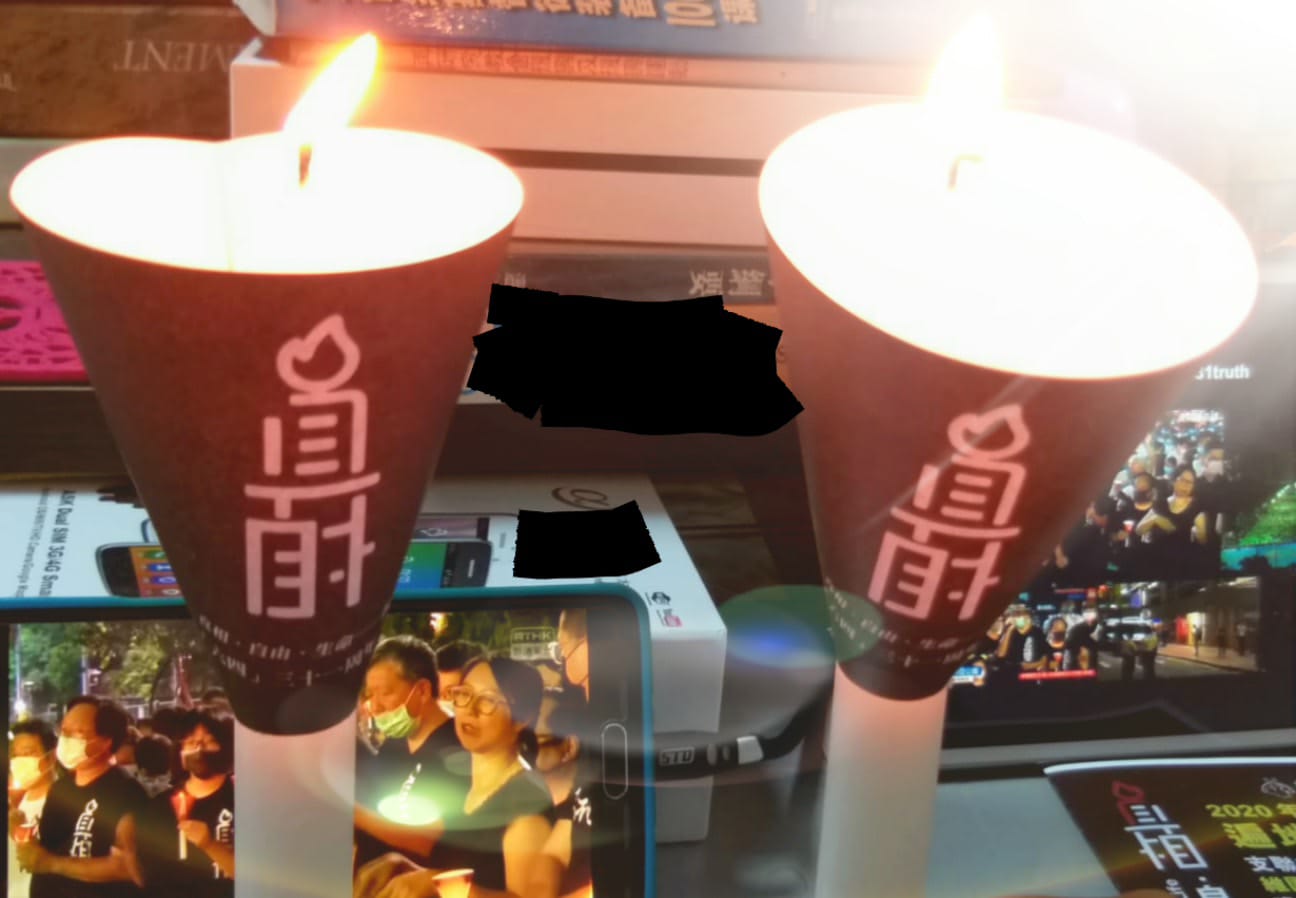
As it happens, the vigil organizers expected this, and came up with a back-up plan – the core group would go to Victoria Park (the usual location for the vigil), have a small scaled down ceremony, and broadcast it live on YouTube. Meanwhile, different districts could hold their own small observances – otherwise everyone who wanted to participate could light candles wherever they were at 8pm and watch the broadcast.

Which is what the bride and I eventually did.


Anyway, the police did what we expected them to do – set up metal barriers all around Victoria Park first thing in the morning to close it off to the public. Around 7pm, the organizers showed up, pulled down the barriers and proceeded as scheduled.

Thousands showed up to join them.


Notice the social distancing.


Interestingly, the police – for once – didn't intervene. There was a pointless skirmish in Mong Kok afterwards, but a relatively minor by HKPF standards, especially considering the protesters essentially outright defied their ban.

Mind you, I'm not giving the police credit for restraint. My hypothesis is that they only held back because (1) the whole world was watching, and (2) Beijing and the HK govt are in the middle of a global propaganda campaign trying to convince the world that the upcoming NSL is nothing to be afraid of and HK will still be all about freedoms and the NSL. Cracking down on a vigil remembering another crackdown on freedom is the last thing they need right now – optics-wise, anyway.

That said, I expect the other shoe to drop eventually. At the very least I think they'll arrest the HK Alliance organizers for illegal assembly etc. Not right away, of course – remember that those 15 activists were arrested for protests that happened months ago. They may wait until after the NSL is passed to inflict maximum damage (pro-Beijing figures have suggested the NSL will be grandfathered to apply it to past activities before the law is enacted – I would be surprised if it isn’t, and we know exactly who the first targets are going to be in that scenario).

Either way, the police are going to make sure the organizers pay for this dearly. And anyone else they decide to punish for showing up.

Anyway, if this has to be the last Tiananmen Square vigil in HK, it was a great way to go out as a massive show of resistance to the coming crackdown.

BONUS TRACK: Oh by the way, the HK govt celebrated June 4 by passing a law that makes mocking, booing or otherwise disrespecting China’s national anthem a crime. Really. The punishment is up to three years in jail.

The govt says it doesn’t impinge on anyone’s freedom of expression because it’s still legal to do it in your own head – just not out loud.

Light a fire,

This is dF
defrog: (Default)
ITEM: Wesley Lowery of 60 Minutes posted a Twitter thread in which he notes that the “police targeting journalists” narrative in the media is problematic in that it infers that the press has (or should have) more First Amendment protection than the protesters who are also being targeted.

The basic thrust is that both the press and protests have explicit freedom guarantees in the 1A, so when both groups’ rights are being violated, why be more outraged over one than the other?

It’s an interesting point – and clearly a good one, because it took me awhile to ponder this before coming up with a sensible reply.

1. First of all, I think it’s entirely possible to be outraged by both, and my impression is that most of the people who support the protests are.

2. That said, I do get Lowery’s point – there is this assumption that journalists should be off-limits in ways that protesters aren’t, and that doesn't seem fair. However, I don’t think it’s an apples-for-apples comparison, because journalists tend to be conferred special status for a couple of key reasons.

3. For a start, there’s the traditionally sanctified role of the press as the “Fourth Estate” in the checks-and-balances structure of the US govt. The watchdog role of media only works if they have the freedom to report without govt recrimination. Indeed, that’s the entire point of having a free press in the first place.

4. The other aspect – and perhaps more relevant to protest coverage – is the age-old notion that in any conflict situation, journalists are ostensibly objective non-combatants on the sidelines tasked with telling people what is happening and why. Yes, the reality is messy and complicated, and some will say there are no true non-combatants in a war zone, but we generally accept the idea that in conflict scenarios, you don’t target people who are not involved in your fight. And journalists are especially off-limits because of Point 3 above.

5. Even more directly related to the protests, journalists are there to not only report that a protest is happening, but also report whatever injustices or abuses of power may occur. And in the broader context of the POTUS himself declaring that any media outlet that is not praising his glory 24/7 is “the enemy of the people” spouting fake news for the purposes of overthrowing him, police brutality against journalists is especially egregious because it amounts to state power wielded by thugs to intimidate and/or punish the "enemy". 

6. By contrast, protesters have specific 1A rights like the press do, but the role and relationship is different. Protests are a mechanism to air grievances en masse to get the government’s attention that enough people are upset about a particular issue that it needs to be addressed ASAP. The objective is also to get the attention of the press, who need the freedom to report unobstructed for the reasons mentioned above. 

7. Where it gets interesting, however, is that 'citizen journalism' is very much a thing in this age of social media and ubiquitous smartphones that are essentially pocket-sized media production studios. So in a practical sense, we are all watchdogs. We are all journalists. So the roles specified in the 1A become blurred at least at street level, if not in a legal sense. We can get into a whole debate about pro journalism vs citizen journalism, and which one is more credible or reliable, etc. But it’s interesting that in the specific example of protests, the distinction between the 1A right to assemble and the 1A right of press freedom isn’t as clear as it used to be.

8. I’m not sure if this is what Lowery had in mind when he wrote that tweet – and it seems like he’s critical of journalists getting (or demanding) special treatment over protesters. I’m not so sure that journalists demand it, but if they do, I suspect it’s for the above reasons rather than any sense of entitlement (though I’m sure there are exceptions).

To be clear, though, Lowery isn’t saying journalists should have less 1A-based immunity from police violence – he’s saying protesters should have as much immunity from police brutality as the press do.

Dude’s got a point.

The weird turn pro,

This is dF
defrog: (Default)

It seems like we’ve crossed some sort of event horizon or cultural Rubicon when I scroll past protest  photos and videos on Twitter and I have to look closely to see if they’re from Hong Kong or Minneapolis.


The parallels are striking, from the excessive and indiscriminate use of tear gas and gratuitously pepper-spraying and arresting reporters to pundits and leaders calling protesters thugs who should be shot and blaming teachers and church leaders for encouraging them.


And not just in Minneapolis, of course. Protests are popping up in other major cities. Even the White House was in lockdown temporarily.


And, you know:


1. To get the obvious out of the way, yes, all four officers should be arrested (Derek Chauvin has finally been charged with murder – the others should at least be charged with accessory), though it seems the police seem to be going with the defense that George Floyd would still be alive if he’d lived a healthier lifestyle, and I don’t see that helping to ease tensions.


2. And yes, institutional racism in America is most definitely a thing, and has been since we were still colonies of the Crown. Trump’s so-called presidency has made things worse, but the problem existed long before he invented Birtherism.


Indeed, the protests are not just about George Floyd. They’re about Kenneth Walker, Breona Taylor, Sean Reed, Ahmaud Arbery, Steve Taylor (and that’s just in the last month) and so on and etc all the way back to Trayvon Martin and Michael Brown and the thousands upon thousands before them – to say nothing of the whole stupid Amy Cooper saga.


3. So IMO the anger and fury of protesters is 100% justified. The violence, not so much, but it’s understandable. MLK Jr told us this way back in the 60s: riots are the language of the unheard, and the inevitable result of systemic injustice – they don’t just magically pop up out of nowhere.


That said, it’s worth adding that protest violence is often the result of police handling the protests badly by escalating tensions rather than defusing them, whether intentionally or by accident. In cases where the police themselves are the object of protest anger, simply showing up in riot gear is almost guaranteed to make a bad situation worse. I’ve seen anecdotal accounts that this is the case in Minneapolis. It’s certainly the case in Hong Kong. Like the saying goes, when you send in riot police, you get a riot.


4. Like in HK, the law-and-order response from Trump and those who worship him has been predictably awful and likely to get people killed. One thing going for the US is that the police is not just one force that takes orders from the White House – it’s a diverse array of local and state forces, and at least some of them are trying to defuse tensions rather than escalate them.


5. It’s hard to know how bad this is going to get. Past history isn't much help – usually, things die down after a few days and we spend the aftermath discussing the problem and generally doing little to address it. Here in 2020, we have a white supremacist in the White House with a cult army of supporters fuelled by paranoid conspiracy theories that liberals, the media and PoC are all out to get them.


I guess we’re lucky the Open Carry buffoons who stormed capital buildings because they couldn't get haircuts on demand haven't shown up at these protests to “help” – not yet, anyway. That could change.


And I don’t even want to think about what all this could mean for the 2020 election.


6. Anyway, as I said, we’ve been living our own version of this in HK for some time now in terms of protests and police brutality. And it's almost like we’ve become a template for Minneapolis – not just the police going crazy with tear gas and targeting reporters (at least the non-white ones), but protesters reportedly throwing tear gas canisters back at police.


So there’s a certain hypocritical irony that Trump advocates shooting black protesters for rioting while he simultaneously takes steps to punish Beijing and the HK govt for oppressing protests here.


That said, I’m not sure he even knows what’s going on here. His statement on HK doesn’t say a word about police brutality or human rights. He’s concerned mainly with HK’s loss of autonomy under 1C2S, and I think he only cares inasmuch as it’s something else he can add to his anti-China rhetoric, which he deploys mostly to entertain his cult and push the nonsense narrative that China – not Trump – is to blame for COVID-19 killing over 100,000 Americans.


Which I only mention because a number of HK people seem to think Trump can somehow save us if he takes action. Thing is, Trump doesn’t care about us, or about human rights in general. He pals around with oppressive authoritarians and ruthless dictators, and even talks about Xi Jinping as a good friend. Sure, it's all in his head. The point is that if his actions do us any good whatsoever, it will be by sheer dumb luck.


And okay, when things look increasingly hopeless as they do here, you can't afford to be picky. If Kim Jong-un or Rodrigo Duterte intervened to save us, we’d probably take it.


Still, the thing about Trump is that his whims turn on a dime, and he regularly undermines his own policies on Twitter. Also, his “plan” is pretty vague and hasn’t actually been enacted yet. Everything depends on details and execution, and it’s always possible that his “solution” to HK will be worse than the problem.

7. Oh, BTW, shoutout to Laura Ingraham for coming up with the worst attempt so far to convince black people that Trump totally understands what they're going through.


Developing …


Revolution earth,


This is dF

defrog: (Default)

The reception to Beijing’s plan to slap a National Security Law (NSL) on Hong Kong in the name of “urgency” – and the HK police’s reaction to that reception – has been about what you’d expect.


Of course, not everyone is freaking out about the NSL. Quite a lot of people welcome it, and have been going around making very conspicuously public statements saying so. Every govt department head has been releasing statements supporting the law – each and every one of them verbatim copies of each other apart from the dept name and corresponding serial number. So you know they’re sincere.


Meanwhile, Beijing officials, HK govt officials and pro-Beijing editors and pundits have spent the last few days making public statements or publishing op-eds assuring everyone (especially the international community) that their fears are unfounded. There is nothing to worry about. All is well.


And so on.


Pretty much all of them boil down to the same basic points:


1. Everyone has national security laws, why can’t we?


2. The NSL will only apply to a tiny, miniscule minority of people. If you are not one of them, you have nothing to fear.


3. The NSL will bring peace and harmony to HK, and all this political turmoil will be a thing of the past, and we can get on with our lives and the economy can recover and everything will be awesome.


I’m not kidding about the last one. Here’s our first CE Tung Chee-hwa saying it. And here’s SCMP columnist Alex Lo calling the NSL a “masterstroke” that means “Hong Kong can now be depoliticised and get back to reviving its economy and improving people’s lives”.


Zounds! Imagine that. Years of polarized politics, frustration at the broken promises of universal suffrage, mistrust of the police, and fears of being “disappeared”, magically wiped away just like that by this one law.


“Well, why didn’t they say so earlier?” etc.


As you might imagine, I find their reassurances rather unreassuring. And one reason (of many) is that not a single one of these people has said exactly HOW the NSL will bring peace and harmony.


Seriously: how? I want one of these people to please spell out for me in detail how NSL will accomplish this in a way that isn't scary or alarming.


None have. I think I can guess why.


I’ve noticed that statements and op-eds opposing the NSL have gone into great detail as to why it’s a bad idea and means the end of One Country Two Systems, giving historical and contemporary context, with numerous examples of how “national security” could be (and already has been) abused in China and elsewhere to stifle and punish opposition.


See for example this column from Cliff Buddle, which ran in SCMP the same day Alex Lo’s column did. He makes a detailed and thoughtful analysis (that saves me a great deal of typing) explaining why there’s good reason to worry about the NSL, and to doubt Beijing’s claims that it will be very narrowly applied.


By contrast, Alex Lo’s column doesn’t back up his assertion at all. He doesn’t explain how the NSL will depoliticize HK, end the protest violence and go back to normal. It simply will. As if the entire problem all along was that we didn't have Draconian enough laws to deal with these punks throwing petrol bombs in the streets. Now that we’re going to have one, problem solved and we can all get along.


There are various reasons for the gaping plot hole in such declarations. For one thing, the people making them are under no obligation to defend their conclusions. It’s not like the law won’t passed if not enough people are convinced that it’s necessary, so why make an effort to back your argument?


For another, the point of these statements is really to be seen publicly declaring sworn loyalty to the new regime. These people know where the power lies, and like good Quislings they’re making sure the Powers That Be point the NSL crosshairs at someone else.


Also, at least for now, no one wants to say the quiet part out loud – the NSL will bring about peace and harmony by using the strong arm of radical law enforcement to terrify the opposition into silence and make examples of anyone who resists.


Voilà: peace and harmony.


This is what China does with its malcontents – this is what the HK govt and its supporters want for HK.


They'll say they don't, of course. And you know, I’m sure many of them imagine in their heads that we’ll still have the same freedoms (or at least they will, because they don't harbour verboten political beliefs, so same thing, really). And maybe some of them actually believe the NSL will be only used against the most violent radicals, and that once those people are dealt with, everyone will be right as rain.


In reality, it's a classic case of trading liberty for security without the slightest understanding just what the price of that security will be. Or maybe they do – and they’re okay with that as long as it’s someone else paying that price.


I wonder how they’ll feel if the price becomes higher than they expected, and where they might draw the line – midnight house raids? Disappearing journalists? Xinjiang-style re-education camps? Tiananmen 2.0?


Welp. We’ll find out.


The price of everything and the value of nothing,


This is dF


defrog: (onoes)

Thursday night, Beijing’s National People's Congress Standing Committee announced it will put forward proposals to enact national security legislation in Hong Kong that will officially make sedition, treason, foreign interference and terrorism crimes in the SAR – bypassing the HK government’s Legislative Council in the process.


By no coincidence, this comes after the HK govt, the HK police, pro-government politicians and Beijing liaison officials police have spent past few months consistently building up the narrative that the protest movement as secessionists and terrorists backed by foreign interference – which just happen to be the exact specific things this bill is targeting.


You see where this is going, yes?


Backgrounder: Under the Basic Law (the mini-constitution that governs Hong Kong under the One Country Two Systems arrangement that allows HK to operate separately from China for 50 years), Article 23 requires the HK govt to enact legislation covering “national security” issues such as sedition, treason and terrorism before its SAR status expires in 2047. This is, to say the least, thorny, because at the time the Basic Law was drafted, everyone knew what the Chinese govt counts as sedition and treason (i.e. simply saying something critical of the govt was equivalent to actively attempting to overthrow it), and that Beijing would naturally expect HK’s law to have similar criteria.


The HK govt first introduced an Article 23 bill in 2003. The response from the HK public was 500,000 people marching on the street to oppose it. The HK govt backed off and didn't bring the matter up again.


Now, in 2020, national security legislation is back, mainly because Beijing (and Carrie Lam, and her crew) have said that it’s the only way to put an end to the protests.


That’s not even remotely true, but it’s the only solution Beijing is interested in because that’s how they handle it on the mainland, and frankly they’re sick of our crap and want to out the fear of God into us. And with HK’s pro-Beijing majority in the Legislative Council not having a big enough majority to railroad legislation through locally, Beijing has evidently decided to bypass LegCo and enact national-security laws here by adding them to Annex III of the Basic Law. HK still has to pass its own national security law under Article 23, but in the meantime, the laws under Annex III will do nicely.

The vote is expected next week.


And so, what then?


I don't know. A lot depends on the details, but there’s no real reason to be optimistic when you loOk at the broader context in which all this is happening. Carrie Lam and her henchmen were just on TV telling us (and the world) that there’s nothing to worry about: we’re still a totally free and open society, and One Country Two Systems will remain completely intact after this bill is passed.


She said that about the extradition bill too.


I mean, these are the same people who just managed to get a long-running political satire program on RTHK taken off the air for the terrible crime of making fun of the police (by a comedian who used to be a police officer!), which to them is no different from actively encouraging people to hate the police. So no, I don't trust them to wield this new power responsibly or fairly.


Is it truly the end of One Country Two Systems?


It’s too soon to say definitively – I think it will continue to exist in the technical sense that HK will still be considered a semi-autonomous region that gets to plan its own economy and have its own version of democracy, etc. But it will be run the way Beijing tells them to run it – and Beijing will be a lot more proactive in doing just that. In terms of free speech, human rights and civil liberties, the HK system may be a separate system, but it will be a system nearly identical to the mainland system, rendering the term another meaningless catch-phrase for Beijing’s foreign ministry spokespeople and the CE to throw around when they respond to international criticism, like “hegemony” and “rule of law”.


How will protesters react?

There’s a march planned for Sunday that the police will almost certainly ban, and will beat up and arrest anyone who tries (as well as anyone who happens to be near anyone who tries, the media and innocent bystanders included). Beyond that, I don’t know. My sense is that the protest movement overall won’t give up – the fact that Beijing is resorting to this shows that the protests has truly rattled the CCP. So stopping now would be a waste of all the effort put in so far.


But they aren’t crazy about another year of sucking tear gas in nightly street fights with riot police either, not least because they know it’s a futile gesture anyway. I’ve heard they’re looking for alternative resistance action plans.


On the other hand, if they feel they truly have nothing to lose, maybe they’ll go out swinging. In which the police would be delighted to accommodate them.


Either way, it seems 2047 has indeed come early.


For more information:


Read this Vox explainer.


Read also this mildly hopeful commentary from Stephen Vines.


The other shoe,


This is dF

defrog: (Default)

You know Hong Kong has got COVID-19 under control when the protest movement kicks back into gear.


Granted, it’s mostly just been people singing the unofficial anthem in malls. But that hasn’t stopped the police from treating them like terrorists about to blow up the place.


Anyway, there are several key differences between last year and this year.


Mary Hui at Quartz lists most of them here, but essentially:


1. Beijing has more aggressively stated its right (and its intention) to dictate affairs in HK, even though the Basic Law (our mini-constitution defining One Country Two Systems) says otherwise.


2. The police has been using social distancing restrictions to harass businesses that support the protest movement, and to arrest protesters.


3. They’ve also been busy arresting top pro-Democracy activists and legislators.


4. In fact, the police are generally much more aggressive now in squashing any potential protest. No applications have been approved, and if so much as five people gather somewhere to protest, the police send in vans full of riot police to dish out gratuitous violence, pepper spray and body searches, And that’s just for the media.


We’ll likely be seeing much more of #4 – the Independent Police Complaints Council has issued its investigative report on police brutality and general handling of protests, and generally found that the police could maybe have done a better job in a few specific situations, but otherwise, keep up the good work.


This wasn't unexpected – the IPCC isn’t as independent as the name makes it out to be, and has no legal powers to investigate most of the complaints beyond comparing the police version of events with the complainant’s accusations. And as the IPCC is mostly run by former cops, you can already guess which side they’re going to give more credence to  (hence one of the Five Demands™ being a truly independent inquiry into police brutality and corruption).


Carrie Lam's official response was also as expected – as far as she's concerned, the report shows the police have been exonerated, and Hong Kong's biggest problem is lying protesters besmirching the police with propaganda and fake news. Naturally, the solution is to stop protesters from spreading fake news. I think we know what that will involve.


The fact that she gave this response whilst standing in front of a huge backdrop saying “The Truth About Hong Kong” kind of says it all, really.


The injustice of it all is heartbreaking. For months we watched the police fire off endless rounds of tear gas, rubber bullets, real bullets, bean bag rounds, pepper rounds and pepper spray not only at the hardline protesters smashing up stuff, but anyone who got in their way, including journalists, first aid responders, social workers, innocent bystanders and legislators trying to broker peace. Less-lethal weapons are supposed to be used to deter imminent threats – HK police are as likely to use them as an exclamation point to assert their authority over you if you so much as look at them funny. They’ve done nothing to keep the peace and everything to ensure violent confrontation.


They’re doing it still. The video evidence of police brutality, irresponsibility and unprofessionalism is staggering. The govt has chosen to pretend it is “fake news” and propaganda spread by the protesters. Now, thanks to the IPCC report, the police have essentially been given a green light to do whatever they want to protesters and anyone who supports them. At most they risk a reprimand (which may be issued with a wink, for all we know).


What happens now?


We don't know. Given that the police have been actively running propaganda campaigns attempting to label the protest movement as a terrorist organization, now would be a good time for the protest movement to shift gears, disavow violence as much as possible and use other tools to resist. I was never a fan of the violent wing of the protest movement, even if they were mostly limiting the targets to property and riot police – partly because I generally oppose violence, but mainly because it plays into the hands of the govt and the police. They WANT the protesters to be violent so they can justify their disproportionately violent response. It plays into their “terrorist” narrative, and the best way to counter that right now is to take no action that could be used to feed that narrative. 


Unfortunately, it seems the govt has a plan to make sure the protest movement stays angry.


Remember how all of this started with the extradition bill that meant HK citizens who just happened to be critical of China could be whisked off to stand trial in China’s notorious judicial system? That bill is now dead, but the govt seems keen to pass new laws that seem almost designed to provoke the same kind of angry reactions as the extradition bill.


For example, the pro-Beijing DAB party is finalizing a bill that makes it a crime to criticize or mock China’s national anthem.


There’s also been talk about solving the problem of the police assaulting journalists by requiring journalists to be accredited by the govt. How would this solve that problem, you ask? I could explain the official reasons, but they would make no sense. Suffice to say the police excuse for assaulting journalists is that a few of them are allegedly protesters pretending to be journalists to escape capture. Which (1) may not even be true, and (2) even if it was, the police are basically arguing that if a suspected criminal hides in a crowd of 100 people and you don't know which one is him, it's in the interest of law and order to pepper-spray and beat up all 100 people to make sure you get him.


The govt will likely follow that up with the infamous Article 23 legislation intended to enact laws in HK against sedition and treason – with the likelihood that its definition of what counts as both will be identical to Beijing’s (i.e. any criticism of the govt whatsoever).


The fact the govt is pushing for all of this at a time when tensions are already sky-high suggests to me they're hoping the protest movement will be angry and desperate enough to do what they did last year – only this time, the police will be under no obligation or pressure to show restraint. Which I reckon is just fine with Beijing. They don’t really want to send in the PLA to shoot protesters and make examples of them – they’d much rather the HK police do that for them, if only for the sake of optics. And the current police chief seems keen on the idea.


So that’s what we have to look forward to in the coming months. The past few months have been mostly quiet, and it was the opportune time for the HK govt to try and find a peaceful way out of this. Turns out they don't want one. 


Cruel summer,


This is dF

defrog: (Default)
Some of you may have seen a news story of a million people protesting on the streets of Hong Kong over a proposed extradition bill.

Here's what that looked like (you'll need to go full-screen to get the full effect – trust me, it's worth it). 


There are good summaries here and here, but the gist of it is:
  • A Hong Kong resident is currently accused of murdering his girlfriend whilst in Taiwan, then fleeing back to HK to avoid prosecution.
  • Hong Kong currently has no extradition arrangement with Taiwan, and is proposing to amend its extradition law to fix that.
  • But to do that, it can’t just set up an extradition agreement with Taiwan – it has to include all of China because technically, HK is part of China, which also officially considers Taiwan to be part of China.
  • This would mean HK residents could be extradited to China.
  • At least 1.03 million HK citizens are concerned about that because we all know that (1) features of China’s judicial system include torture, forced confessions, and trumped up evidence, and (2) under China’s rule of law, making jokes about Xi Jinping counts as trying to overthrow the government.
Beijing-approved Chief Executive Carrie Lam – who has been pushing for the amendment – swears that (1) the amendment will only apply to major crimes committed in China like theft and murder, so Beijing will not be able to use the law to punish HK people for political speech that would be illegal on the mainland, (2) HK will have full control over which extradition requests are approved, and (3) HK courts will have the final word.

Opponents don’t really believe her. And there’s no reason they should.

1. For a start, in the past 22 years since the handover, numerous Beijing officials have made it perfectly clear – repeatedly – that when it comes to how the HK govt runs its affairs (especially when it comes to democratic election processes) it is Beijing who has the final say precisely because they own us – we’re part of China, our autonomy is not absolute, and don’t ever forget that.

2. Meanwhile, the HK govt has in the past blocked certain Chinese dissidents from entering the city, and recently refused to renew the visa of a foreign journalist – and denied him entry back into HK – because he moderated an event where the main speaker was a pro-independence activist (whose political party has been banned). The govt has always claimed these actions were not due to pressure from Beijing – but not a lot of people believe that.

3. Also, while theoretically you would have to be in China when your alleged crime took place, in reality China has been known to finesse that particular detail.

So when CE Lam says, “Don’t worry, we have the power to turn down any request that looks politically motivated,” it’s not particularly reassuring. Even if she’s sincere, it’s hard to imagine Beijing talking no for an answer, or CE Lam standing up to them if they pressure her to change her mind.

4. It’s even less reassuring when remembering that the last time HK had a protest anywhere near this size (2003), it was over a proposed National Security bill that would, among other things, “prohibit any act of treason, secession, sedition, subversion against the Central People's Government” – with Beijing of course having the final say on what counted as any of those things.

After the protest the bill was shelved, but Article 23 of the Basic Law (our mini-constitution) requires us to pass one sooner or later. And after the Occupy stunt of 2014 and the subsequent rise of the tiny pro-independence faction, some pro-Beijing officials have suggested we put that back on the table soon. You can guess who might be the first people or groups charged under that law.

So you can see why people aren’t feeling very reassured by CE Lam’s claims that It Can’t Happen Here and to just trust her that everything will be fine. Ultimately, it’s not so much that people don’t trust the bill – they don’t trust Beijing to adhere to the law’s safeguards or respect HK’s decisions on politically motivated cases. And they don’t trust CE Lam because (like all CEs) she was vetted and elected by 1200 electors approved by Beijing.

So … what happens now?

Well, for a start, CE Lam isn’t backing down. The extradition bill is due for a second and third reading tomorrow, and LegCo has been instructed to have a final vote by Thursday next week.

Meanwhile, another protest is being planned for tomorrow. Over 100 businesses – including some of the major banks in town – have publicly announced they will either close or adopt flexi-hours so that their employees can attend the protest. That right there should tell you how serious the opposition to this bill is.

In fact, pretty much no one apart from CE Lam, the pro-establishment parties and Beijing itself is in favour of the bill. Even Taiwan has said they don’t want HK to pass the bill just so they can prosecute the murder suspect – they would much rather have a one-off arrangement.

So, the big questions are:

1. Why is CE Lam hellbent on pushing this bill when she knows how immensely unpopular it is?
2. Has she considered what the reaction of the public and the business sector is going to be if it does pass?
3. Does she have a contingency plan to deal with that?

We’ll find out. But it’s hard to believe she doesn’t know how divisive this bill is, and that passing it is going to make things worse. Granted, it’s not like her re-election is at stake. But does she really want to risk serious social upheaval by ignoring all those concerns or pretending they don’t matter simply because she thinks she’s right? Does she really think passing this bill is so important that it's worth ripping the city apart? 

The only hope now is that LegCo votes against the bill – which isn’t likely since the pro-Beijing camp outnumbers the opposition by a pretty big margin. Maybe they’ll feel enough voter pressure to rethink their position. Maybe they won’t.

All I’m really sure of is that between now and the final vote, we’re in for an ugly week.

Into the aggro,

This is dF

Profile

defrog: (Default)
defrog

March 2026

S M T W T F S
1234567
891011121314
15161718192021
222324252627 28
293031    

Syndicate

RSS Atom

Most Popular Tags

Style Credit

Expand Cut Tags

No cut tags
Page generated Apr. 4th, 2026 04:50 pm
Powered by Dreamwidth Studios