![[personal profile]](https://www.dreamwidth.org/img/silk/identity/user.png) defrog
defrogBurning through the to-read pile like Mario Andretti, y’all.
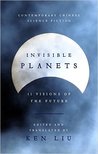 Invisible Planets by Ken Liu
My rating: 3 of 5 stars
Most of my early SF/F intake originated from either the US or UK, so for a long time now I’ve been interested in how writers in other countries approach SF/F, especially here in Asia where I live. Chinese science fiction is generating a lot of interest outside of China, thanks mainly to the success of Cixin Liu’s The Three-Body Problem. This anthology – edited and translated by SF/F author Ken Liu, who also translated The Three-Body Problem and other Chinese SF works – collects 13 stories from seven contemporary Chinese SF writers (including Cixin Liu, who contributes two stories here). There are also short essays from three of the authors regarding SF in China.
What’s most notable about this collection – apart from getting an interesting glimpse into how Chinese writers approach SF, and the fact that four of the featured authors are women – is the variety. Like western SF (which has been an influence on SF in China from time to time), Chinese SF is pretty diverse, covering hard SF, alien contact, cyberpunk, Big Brother dystopias, bio-horror, post-apocalyptic robots, Gaimanesque spirit worlds, surrealist mythology and interplanetary travelogues, among others. Like many anthologies, there’s something for everyone, but not everything may be your cup of tea. Personally, the highlights for me were the contributions from Cixin Liu, Ma Boyang and Tang Fei, and a couple of the stories from Xia Jia.
 Autonomous by Annalee Newitz
My rating: 3 of 5 stars
I’ve known about Annalee Newitz for years via her work as founding editor of io9 – between that and the rave reviews I’d read about this debut novel by her, I was keen to pick this up. The jacket synopsis sounded promising too – in the year 2144, Jack Chen is a pharmaceutical pirate who violates ultra-strict patent laws by making and distributing cheap copies of drugs to benefit poor people. When her pirated copy of pre-release Zacuity – a drug that literally helps you love your job – starts killing people, she races to find an antidote whilst on the run from two international patent enforcers – one of which is an indentured military-grade robot named Paladin that starts to develop an unexpected relationship with his partner Eliasz.
The chase plot is ostensibly a vehicle for Newitz to explore several ideas – the corporate notion of intellectual property taken to extremes (i.e. not just in terms of pharmaceuticals and sentient robots but even people who are born as corporate “property” – slaves, in other words), the emotional relationships between humans and robots (to include sex and even gender identity), and the meaning of true autonomy in such a world. Ultimately Newitz raises far more questions than answers – which is good in the sense that many of them are questions worth asking (even the uncomfortable ones), but some questions were the result of me not being able to buy into a couple of plot points, from aspects of the Eliasz/Paladin relationship to the rationale of the indenture system – to say nothing of the hackneyed “corporations are one-dimensionally evil just because” meme. Even if you frame it as a "what if" scenario rather than a predictive one, parts of her 2144 were a little unconvincing for me.
Another problem is that there are few likeable or sympathetic characters, apart from some of the robots – which may have been intentional, and if so, point made, but still. On the other hand, for the most part they’re believable characters, even if I had trouble identifying with most of them. As debut novels go, it’s pretty good and decidedly provocative – and Newitz demonstrates a gift for dialogue and pure inventiveness (I particularly love how she structures her robot-to-robot conversations), and it’s good enough that I’m likely to try her next novel. But ultimately it does come off to me as preaching to a particular choir, and people like me who aren’t full-time members might have trouble getting into it.
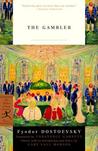 The Gambler by Fyodor Dostoyevsky
My rating: 4 of 5 stars
According to legend, this short novel from Dostoevsky was not only based on his own experience with gambling addiction, but also written quickly under a strict contract so he could pay off his gambling debts. The narrator, Alexei Ivanovich, is a tutor for a Russian family living in a hotel in Germany, all of whom are living a wealthy lifestyle but massively in debt in some way or other. The head of the family, referred to only as The General, is banking on his wealthy but ill grandmother in Moscow kicking the bucket soon to pay off his debts, which will also enable him to marry a French noblewoman who will only marry him if he’s loaded.
As for what all this has to do with gambling, part of it is related to Alexei Ivanovich being in love with the General’s stepdaughter Polina, who has debts of her own. She sends Alexei to the local casino to earn some money for her, and having never gambled before, he eventually gets hooked. There’s more to it than that, but I wouldn’t want to give away the big surprise in the story.
I have to admit this turned out to be a different novel than I was expecting – in a good way. What I thought might be a miserable road-to-ruin cautionary tale of gambling addiction turned out to be more of a satirical comedy of fiscal responsibility. For all Alexei’s manic behavior towards Polina and his eventual obsession with gambling, he’s arguably the most level-headed person in the story compared to almost everyone else, who are so obsessed with wealth and nobility that they’ll rack up massive debts to achieve both. I don’t know if Dostoevsky intended this to be a comedy, but it does have a mapcap quality to it. Once you work through the thicket of background/set-up to get up to speed with who everyone is and why they’re there (endnotes are your friend), it’s a strikingly entertaining story.
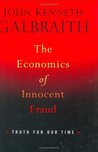 The Economics of Innocent Fraud: Truth for Our Time by John Kenneth Galbraith
My rating: 2 of 5 stars
I picked this up partly because it was dirt cheap (as part of a charity sale), and partly because I read and liked John Kenneth Galbraith’s The Great Crash of 1929 a few years back. This is Galbraith’s final book before he passed away in 2006 – a 62-page essay that is essentially a summary of his previously stated views on economic life circa 2004. In essence, Galbraith maintains that proper capitalism has long been replaced by a market economy in which corporate bureaucracies rule with power that is not held in check by sufficient regulation, consumer sovereignty or even the actual owners, and that most of the tenets of what politicians, Wall Street and the business press routinely laud as free-market capitalism – the invisible hand, market forces, the clear division between the private and public sector, etc – amount to a revered mythology that is nowhere close to reality. Galbraith describes this as “innocent fraud” – with tongue planted firmly in cheek, as he notes the degree of “innocence" regarding certain practices varies.
Obviously, what you make of this will likely depend in part on your current political affiliation and the degree to which you subscribe to the very mythology Galbraith criticizes. Personally – and as someone who (1) knows very little about economics and (2) considers himself more or less a centrist – I think he’s not wrong, for the most part. Hindsight goes a long way here – Galbraith wrote this just after Enron happened but before the 2008 economic meltdown, the root cause of which seems to retroactively validate a lot of Galbraith’s criticisms.
Where the book goes wrong – and the reason I’m not giving it more stars – is that Galbraith’s whimsically staccato writing style makes it a lot harder to read than is arguably necessary, even for a Harvard intellectual. Also, Galbraith offers little to back up most of his observations – it’s as though he felt his own career, experience and reputation as an economist to be all the empirical evidence you need that he’s right. It doesn’t mean he’s wrong, necessarily – but if you’re going to declare “conventional wisdom” a fraud (innocent or otherwise), it’s usually advisable to provide evidence to back your case.
 The Night Masquerade by Nnedi Okorafor
My rating: 4 of 5 stars
This is third instalment of the Binti series, and the first thing I should say is that I’m impressed that overall story arc didn’t follow the path I expected. The original novella (which I loved) seemed like a set-up to follow Binti and her alien enemy-turned-friend Okwu as they studied far-out science at Oozma Uni. Instead, the series has focused on Binti’s struggle to understand her increasingly complicated identity, and how difficult it is to cling to cultural traditions whilst simultaneously trying to move beyond them – which is far more interesting.
The Night Masquerade takes place where Home left off, as Binti – transformed by her experience in the desert – rushes home to her family, who are in danger as the ancient war between the Earth-based Khoush and the Meduse (Okwu’s people) threatens to reignite, with Binti’s tribe (the Himba) caught in the crossfire.
The resulting story is both fascinating and somewhat frustrating – one key plot twist just seemed too obvious a thing for the characters to have overlooked, while another key plot twist was not only predictable but came off as a little contrived to me. Which might not count against it except that the first two books didn’t have that particular issue, so it’s a little disappointing in that regard. That said, warts and all, it’s still an exciting, page-turning finale to an excellent character-driven series.
 The Dispatcher by John Scalzi
My rating: 4 of 5 stars
This novella was initially written as an audio book, then later released as a print/e-book, rather than the other way round. I read the e-book version, and on the one hand I can sort of tell it was initially written to be heard rather than read – the narrative skews towards dialogue over action and doesn’t spend a lot of time on description. On the other hand, Scalzi’s books almost always tend to be dialogue-driven, so I’m not sure I would have guessed it started life as an audio book if I hadn’t already known that.
Apart from the format experiment, this is also something of a departure for Scalzi as he tries his hand at urban fantasy/police procedural with a weird but interesting premise: people who are killed by other people – intentionally or otherwise – come back to life unharmed (or at least in the condition they were in a few hours before they were killed), although 999 times out 1,000 they stay dead. One eventual result of this new reality is the creation of an agency that employs ‘dispatchers’ – agents authorized by the govt to humanely kill critically injured or ill people in order to save them.
Scalzi explores this concept via Tony Valdez, a dispatcher roped into a police investigation when one of his fellow dispatchers goes missing. The mystery itself is interesting – can you get away with murder in a world where your victim won't stay dead? – but so is the background world and the societal consequences that result in such a world. Scalzi leaves a lot of potential ground uncovered and doesn’t dig too deeply – mainly due to the length and audio-format limitations, I presume – but he does manage to cover quite a bit of ground within those limitations, such as the ethics of dispatching and the return of duelling. In any case, it’s an entertaining and thought-provoking story, and it’s a world I hope Scalzi returns to one day, because there’s a lot to play with here.
View all my reviews
I shall return,
This is dF
Invisible Planets by Ken LiuMy rating: 3 of 5 stars
Most of my early SF/F intake originated from either the US or UK, so for a long time now I’ve been interested in how writers in other countries approach SF/F, especially here in Asia where I live. Chinese science fiction is generating a lot of interest outside of China, thanks mainly to the success of Cixin Liu’s The Three-Body Problem. This anthology – edited and translated by SF/F author Ken Liu, who also translated The Three-Body Problem and other Chinese SF works – collects 13 stories from seven contemporary Chinese SF writers (including Cixin Liu, who contributes two stories here). There are also short essays from three of the authors regarding SF in China.
What’s most notable about this collection – apart from getting an interesting glimpse into how Chinese writers approach SF, and the fact that four of the featured authors are women – is the variety. Like western SF (which has been an influence on SF in China from time to time), Chinese SF is pretty diverse, covering hard SF, alien contact, cyberpunk, Big Brother dystopias, bio-horror, post-apocalyptic robots, Gaimanesque spirit worlds, surrealist mythology and interplanetary travelogues, among others. Like many anthologies, there’s something for everyone, but not everything may be your cup of tea. Personally, the highlights for me were the contributions from Cixin Liu, Ma Boyang and Tang Fei, and a couple of the stories from Xia Jia.
Autonomous by Annalee NewitzMy rating: 3 of 5 stars
I’ve known about Annalee Newitz for years via her work as founding editor of io9 – between that and the rave reviews I’d read about this debut novel by her, I was keen to pick this up. The jacket synopsis sounded promising too – in the year 2144, Jack Chen is a pharmaceutical pirate who violates ultra-strict patent laws by making and distributing cheap copies of drugs to benefit poor people. When her pirated copy of pre-release Zacuity – a drug that literally helps you love your job – starts killing people, she races to find an antidote whilst on the run from two international patent enforcers – one of which is an indentured military-grade robot named Paladin that starts to develop an unexpected relationship with his partner Eliasz.
The chase plot is ostensibly a vehicle for Newitz to explore several ideas – the corporate notion of intellectual property taken to extremes (i.e. not just in terms of pharmaceuticals and sentient robots but even people who are born as corporate “property” – slaves, in other words), the emotional relationships between humans and robots (to include sex and even gender identity), and the meaning of true autonomy in such a world. Ultimately Newitz raises far more questions than answers – which is good in the sense that many of them are questions worth asking (even the uncomfortable ones), but some questions were the result of me not being able to buy into a couple of plot points, from aspects of the Eliasz/Paladin relationship to the rationale of the indenture system – to say nothing of the hackneyed “corporations are one-dimensionally evil just because” meme. Even if you frame it as a "what if" scenario rather than a predictive one, parts of her 2144 were a little unconvincing for me.
Another problem is that there are few likeable or sympathetic characters, apart from some of the robots – which may have been intentional, and if so, point made, but still. On the other hand, for the most part they’re believable characters, even if I had trouble identifying with most of them. As debut novels go, it’s pretty good and decidedly provocative – and Newitz demonstrates a gift for dialogue and pure inventiveness (I particularly love how she structures her robot-to-robot conversations), and it’s good enough that I’m likely to try her next novel. But ultimately it does come off to me as preaching to a particular choir, and people like me who aren’t full-time members might have trouble getting into it.
The Gambler by Fyodor DostoyevskyMy rating: 4 of 5 stars
According to legend, this short novel from Dostoevsky was not only based on his own experience with gambling addiction, but also written quickly under a strict contract so he could pay off his gambling debts. The narrator, Alexei Ivanovich, is a tutor for a Russian family living in a hotel in Germany, all of whom are living a wealthy lifestyle but massively in debt in some way or other. The head of the family, referred to only as The General, is banking on his wealthy but ill grandmother in Moscow kicking the bucket soon to pay off his debts, which will also enable him to marry a French noblewoman who will only marry him if he’s loaded.
As for what all this has to do with gambling, part of it is related to Alexei Ivanovich being in love with the General’s stepdaughter Polina, who has debts of her own. She sends Alexei to the local casino to earn some money for her, and having never gambled before, he eventually gets hooked. There’s more to it than that, but I wouldn’t want to give away the big surprise in the story.
I have to admit this turned out to be a different novel than I was expecting – in a good way. What I thought might be a miserable road-to-ruin cautionary tale of gambling addiction turned out to be more of a satirical comedy of fiscal responsibility. For all Alexei’s manic behavior towards Polina and his eventual obsession with gambling, he’s arguably the most level-headed person in the story compared to almost everyone else, who are so obsessed with wealth and nobility that they’ll rack up massive debts to achieve both. I don’t know if Dostoevsky intended this to be a comedy, but it does have a mapcap quality to it. Once you work through the thicket of background/set-up to get up to speed with who everyone is and why they’re there (endnotes are your friend), it’s a strikingly entertaining story.
The Economics of Innocent Fraud: Truth for Our Time by John Kenneth GalbraithMy rating: 2 of 5 stars
I picked this up partly because it was dirt cheap (as part of a charity sale), and partly because I read and liked John Kenneth Galbraith’s The Great Crash of 1929 a few years back. This is Galbraith’s final book before he passed away in 2006 – a 62-page essay that is essentially a summary of his previously stated views on economic life circa 2004. In essence, Galbraith maintains that proper capitalism has long been replaced by a market economy in which corporate bureaucracies rule with power that is not held in check by sufficient regulation, consumer sovereignty or even the actual owners, and that most of the tenets of what politicians, Wall Street and the business press routinely laud as free-market capitalism – the invisible hand, market forces, the clear division between the private and public sector, etc – amount to a revered mythology that is nowhere close to reality. Galbraith describes this as “innocent fraud” – with tongue planted firmly in cheek, as he notes the degree of “innocence" regarding certain practices varies.
Obviously, what you make of this will likely depend in part on your current political affiliation and the degree to which you subscribe to the very mythology Galbraith criticizes. Personally – and as someone who (1) knows very little about economics and (2) considers himself more or less a centrist – I think he’s not wrong, for the most part. Hindsight goes a long way here – Galbraith wrote this just after Enron happened but before the 2008 economic meltdown, the root cause of which seems to retroactively validate a lot of Galbraith’s criticisms.
Where the book goes wrong – and the reason I’m not giving it more stars – is that Galbraith’s whimsically staccato writing style makes it a lot harder to read than is arguably necessary, even for a Harvard intellectual. Also, Galbraith offers little to back up most of his observations – it’s as though he felt his own career, experience and reputation as an economist to be all the empirical evidence you need that he’s right. It doesn’t mean he’s wrong, necessarily – but if you’re going to declare “conventional wisdom” a fraud (innocent or otherwise), it’s usually advisable to provide evidence to back your case.
The Night Masquerade by Nnedi OkoraforMy rating: 4 of 5 stars
This is third instalment of the Binti series, and the first thing I should say is that I’m impressed that overall story arc didn’t follow the path I expected. The original novella (which I loved) seemed like a set-up to follow Binti and her alien enemy-turned-friend Okwu as they studied far-out science at Oozma Uni. Instead, the series has focused on Binti’s struggle to understand her increasingly complicated identity, and how difficult it is to cling to cultural traditions whilst simultaneously trying to move beyond them – which is far more interesting.
The Night Masquerade takes place where Home left off, as Binti – transformed by her experience in the desert – rushes home to her family, who are in danger as the ancient war between the Earth-based Khoush and the Meduse (Okwu’s people) threatens to reignite, with Binti’s tribe (the Himba) caught in the crossfire.
The resulting story is both fascinating and somewhat frustrating – one key plot twist just seemed too obvious a thing for the characters to have overlooked, while another key plot twist was not only predictable but came off as a little contrived to me. Which might not count against it except that the first two books didn’t have that particular issue, so it’s a little disappointing in that regard. That said, warts and all, it’s still an exciting, page-turning finale to an excellent character-driven series.
The Dispatcher by John ScalziMy rating: 4 of 5 stars
This novella was initially written as an audio book, then later released as a print/e-book, rather than the other way round. I read the e-book version, and on the one hand I can sort of tell it was initially written to be heard rather than read – the narrative skews towards dialogue over action and doesn’t spend a lot of time on description. On the other hand, Scalzi’s books almost always tend to be dialogue-driven, so I’m not sure I would have guessed it started life as an audio book if I hadn’t already known that.
Apart from the format experiment, this is also something of a departure for Scalzi as he tries his hand at urban fantasy/police procedural with a weird but interesting premise: people who are killed by other people – intentionally or otherwise – come back to life unharmed (or at least in the condition they were in a few hours before they were killed), although 999 times out 1,000 they stay dead. One eventual result of this new reality is the creation of an agency that employs ‘dispatchers’ – agents authorized by the govt to humanely kill critically injured or ill people in order to save them.
Scalzi explores this concept via Tony Valdez, a dispatcher roped into a police investigation when one of his fellow dispatchers goes missing. The mystery itself is interesting – can you get away with murder in a world where your victim won't stay dead? – but so is the background world and the societal consequences that result in such a world. Scalzi leaves a lot of potential ground uncovered and doesn’t dig too deeply – mainly due to the length and audio-format limitations, I presume – but he does manage to cover quite a bit of ground within those limitations, such as the ethics of dispatching and the return of duelling. In any case, it’s an entertaining and thought-provoking story, and it’s a world I hope Scalzi returns to one day, because there’s a lot to play with here.
View all my reviews
I shall return,
This is dF
