![[personal profile]](https://www.dreamwidth.org/img/silk/identity/user.png)
Cranking them out, Jim.
 Trees, Vol. 1: In Shadow by Warren Ellis
My rating: 4 of 5 stars
Leave it to Warren Ellis to come up with an idea like this: giant alien objects land on Earth … and just stand there like trees, completely oblivious to any indigenous life, including us. Or are they? This first collected volume follows several storylines set ten years after the arrival of the Trees in different locations: an art student in China, a small-time gangster moll in Italy, a ruthless president in Mogadishu, and a research team in Spitzbergen. Each story reveals the effect the Trees are having on the local society/ecosystem, and that there may be more to them than it appears. All in all, this is one of Ellis’ more original ideas, and he makes good use of it as a springboard for stories. It's also good (and brave) that he takes a global approach, although sometimes Jason Howard’s art lets him down (maybe it’s me, but it seems like at least three main female characters look more or less alike, despite being different ethnicities). Anyway, there’s a lot to like here, and it does end on a cliffhanger, so count me in for Volume 2.
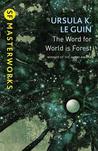 The Word for World is Forest by Ursula K. Le Guin
My rating: 4 of 5 stars
In this expanded novella from Le Guin’s Hain Cycle, humans start a logging operation on the planet of Athshe (dubbed “New Tahiti”), where all available land is forest. The indigenous Athsheans – whose culture is non-violent and centered on lucid dreaming – are enslaved to work as servants and laborers. After vicious camp boss Captain Davidson rapes and kills one of the female Athsheans, her husband Selver starts a revolution to fight back. Le Guin wrote this during the height of the Vietnam War, and while it’s not the same situation duplicated on an alien planet, the allegory isn’t subtle, which is both a positive and a negative. What gives it extra weight and depth is Le Guin’s acknowledgment that the decision to renounce peace in favor of violence has lasting and perhaps irreversible consequences, making this far more than a simple revenge story. The parts that describe the Athsheans’ dream culture are somewhat challenging to grasp (at least for me), but on the whole this is powerful stuff. Le Guin is fast becoming one of my favorite authors.
 The Martian by Andy Weir
My rating: 3 of 5 stars
I wasn’t especially in a hurry to read this before the film version came out, but I saw it at half-price in a clearance sale recently, and I did plan to read it eventually, so why not? Thanks to the film trailers you probably already know the deal: Presumed to have been killed in a dust storm during an emergency evacuation, astronaut Mark Watney is stranded on Mars, and must figure out how to survive long enough for the next scheduled Mars mission to arrive. The result is not so much a rumination on the psychological impact of such a situation so much as a Mars Survival Guide For Science Nerds. Which is not a bad thing – Watney displays remarkable ingenuity throughout, even when things go wrong, and Weir keeps the narrative light and breezy to help you through the heavy science. On the other hand, it’s a little too fun – Watney basically MacGuyver’s his way through the story with wisecracks and cool-headed cheerfulness the majority of the time, so there’s not a lot of emotional depth to him. Also, it’s sometimes a little too convenient that he just happens to have the right knowledge skills and materials on hand to tackle each problem. Luckily, that’s somewhat balanced out by the drama and gravitas back at NASA once they realize Watney’s still alive and work out how to rescue him. And it all pays off with a page-turning ending. It’s light entertainment (with science), but it’s well done.
 The Shadow of the Wind by Carlos Ruiz Zafón
My rating: 3 of 5 stars
This is my second time reading Ruiz Zafón, following his YA novel Marina. I liked that enough to try him again, and this book, his first adult novel and the first of the Cemetery Of Forgotten Books series, has a great hook: young Daniel is initiated to the Cemetery Of Forgotten Books in Barcelona after he selects a book by Julian Carax, which according to tradition he must protect for life. Once he discovers that someone has been destroying Carax’s other books, he decides to find out why, and soon finds himself in big trouble. In many ways, it’s an expansion of Marina (which was written and published before this one) in terms of M.O.: both are a coming-of-age Gothic mystery that is solved by people telling stories about people telling stories about other people until the horrible truth is finally revealed with a not-all-that-surprising plot twist and a somewhat cheesy climax. The Shadow Of The Wind takes that template to a grander scale, with the plot, subplots and sub-subplots adding up to one big dense convoluted soap opera. On the plus side, it comes with an interesting historical backdrop (the Spanish Civil War and Franco’s subsequent reign) and some very engaging characters. And because I travel to Barcelona once a year (it’s where I bought my copy of this book, in fact), I had a good frame of reference for the setting (which isn’t necessary, just cool). Overall I liked it, but I think I’ll need a breather before I try the next book in this series.
 Data and Goliath: The Hidden Battles to Collect Your Data and Control Your World by Bruce Schneier
Bruce Schneier’s latest book tackles the problem of privacy in the Digital Age when just about everyone from Google and Facebook to mobile operators and the NSA are hoovering up every byte of data you generate on the internet, storing it and using it for various reasons, some beneficial to you, but many of them otherwise (just ask the client base of Ashley Madison). It all amounts to massive surveillance on a level that would make Big Brother blush, and it can't be stopped. Or can it? That could be the set-up for a paranoid anti-corporate/anti-govt rant, but Schneier, as always, takes this on with a level head, explains the good and bad sides of this new reality, and what should be done about it while there’s still time. If you read his blog regularly (as well as his other books), much of this will sound familiar. But Schneier really does a good job of summing up this particular problem, explaining why it’s a problem, why you should care, and what actions you can consider taking, and – thankfully – he does it without going off on angry political tangents or proposing quick fixes. Even where his solutions aren't that realistic (which he freely admits is the case), they can at least get a discussion going to generate better ideas (hopefully). I generally recommend Schneier’s books to anyone who wants to understand the post-9/11 world we live in. As pervasive as social media, mobile apps and the NSA have become, this book should be required reading for … well, everyone.
View all my reviews
I like to watch,
This is dF
Trees, Vol. 1: In Shadow by Warren EllisMy rating: 4 of 5 stars
Leave it to Warren Ellis to come up with an idea like this: giant alien objects land on Earth … and just stand there like trees, completely oblivious to any indigenous life, including us. Or are they? This first collected volume follows several storylines set ten years after the arrival of the Trees in different locations: an art student in China, a small-time gangster moll in Italy, a ruthless president in Mogadishu, and a research team in Spitzbergen. Each story reveals the effect the Trees are having on the local society/ecosystem, and that there may be more to them than it appears. All in all, this is one of Ellis’ more original ideas, and he makes good use of it as a springboard for stories. It's also good (and brave) that he takes a global approach, although sometimes Jason Howard’s art lets him down (maybe it’s me, but it seems like at least three main female characters look more or less alike, despite being different ethnicities). Anyway, there’s a lot to like here, and it does end on a cliffhanger, so count me in for Volume 2.
The Word for World is Forest by Ursula K. Le GuinMy rating: 4 of 5 stars
In this expanded novella from Le Guin’s Hain Cycle, humans start a logging operation on the planet of Athshe (dubbed “New Tahiti”), where all available land is forest. The indigenous Athsheans – whose culture is non-violent and centered on lucid dreaming – are enslaved to work as servants and laborers. After vicious camp boss Captain Davidson rapes and kills one of the female Athsheans, her husband Selver starts a revolution to fight back. Le Guin wrote this during the height of the Vietnam War, and while it’s not the same situation duplicated on an alien planet, the allegory isn’t subtle, which is both a positive and a negative. What gives it extra weight and depth is Le Guin’s acknowledgment that the decision to renounce peace in favor of violence has lasting and perhaps irreversible consequences, making this far more than a simple revenge story. The parts that describe the Athsheans’ dream culture are somewhat challenging to grasp (at least for me), but on the whole this is powerful stuff. Le Guin is fast becoming one of my favorite authors.
The Martian by Andy WeirMy rating: 3 of 5 stars
I wasn’t especially in a hurry to read this before the film version came out, but I saw it at half-price in a clearance sale recently, and I did plan to read it eventually, so why not? Thanks to the film trailers you probably already know the deal: Presumed to have been killed in a dust storm during an emergency evacuation, astronaut Mark Watney is stranded on Mars, and must figure out how to survive long enough for the next scheduled Mars mission to arrive. The result is not so much a rumination on the psychological impact of such a situation so much as a Mars Survival Guide For Science Nerds. Which is not a bad thing – Watney displays remarkable ingenuity throughout, even when things go wrong, and Weir keeps the narrative light and breezy to help you through the heavy science. On the other hand, it’s a little too fun – Watney basically MacGuyver’s his way through the story with wisecracks and cool-headed cheerfulness the majority of the time, so there’s not a lot of emotional depth to him. Also, it’s sometimes a little too convenient that he just happens to have the right knowledge skills and materials on hand to tackle each problem. Luckily, that’s somewhat balanced out by the drama and gravitas back at NASA once they realize Watney’s still alive and work out how to rescue him. And it all pays off with a page-turning ending. It’s light entertainment (with science), but it’s well done.
The Shadow of the Wind by Carlos Ruiz ZafónMy rating: 3 of 5 stars
This is my second time reading Ruiz Zafón, following his YA novel Marina. I liked that enough to try him again, and this book, his first adult novel and the first of the Cemetery Of Forgotten Books series, has a great hook: young Daniel is initiated to the Cemetery Of Forgotten Books in Barcelona after he selects a book by Julian Carax, which according to tradition he must protect for life. Once he discovers that someone has been destroying Carax’s other books, he decides to find out why, and soon finds himself in big trouble. In many ways, it’s an expansion of Marina (which was written and published before this one) in terms of M.O.: both are a coming-of-age Gothic mystery that is solved by people telling stories about people telling stories about other people until the horrible truth is finally revealed with a not-all-that-surprising plot twist and a somewhat cheesy climax. The Shadow Of The Wind takes that template to a grander scale, with the plot, subplots and sub-subplots adding up to one big dense convoluted soap opera. On the plus side, it comes with an interesting historical backdrop (the Spanish Civil War and Franco’s subsequent reign) and some very engaging characters. And because I travel to Barcelona once a year (it’s where I bought my copy of this book, in fact), I had a good frame of reference for the setting (which isn’t necessary, just cool). Overall I liked it, but I think I’ll need a breather before I try the next book in this series.
Data and Goliath: The Hidden Battles to Collect Your Data and Control Your World by Bruce SchneierBruce Schneier’s latest book tackles the problem of privacy in the Digital Age when just about everyone from Google and Facebook to mobile operators and the NSA are hoovering up every byte of data you generate on the internet, storing it and using it for various reasons, some beneficial to you, but many of them otherwise (just ask the client base of Ashley Madison). It all amounts to massive surveillance on a level that would make Big Brother blush, and it can't be stopped. Or can it? That could be the set-up for a paranoid anti-corporate/anti-govt rant, but Schneier, as always, takes this on with a level head, explains the good and bad sides of this new reality, and what should be done about it while there’s still time. If you read his blog regularly (as well as his other books), much of this will sound familiar. But Schneier really does a good job of summing up this particular problem, explaining why it’s a problem, why you should care, and what actions you can consider taking, and – thankfully – he does it without going off on angry political tangents or proposing quick fixes. Even where his solutions aren't that realistic (which he freely admits is the case), they can at least get a discussion going to generate better ideas (hopefully). I generally recommend Schneier’s books to anyone who wants to understand the post-9/11 world we live in. As pervasive as social media, mobile apps and the NSA have become, this book should be required reading for … well, everyone.
View all my reviews
I like to watch,
This is dF
