![[personal profile]](https://www.dreamwidth.org/img/silk/identity/user.png) defrog
defrogWell, pretty fast, anyway.
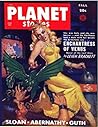 Enchantress Of Venus by Leigh Brackett
My rating: 2 of 5 stars
Continuing my exploration of the works of Leigh Brackett, this is the second of her Eric John Stark novellas, which I would have read before the third one, Black Amazon of Mars, if I’d realised at the time there was a copy of it on Project Gutenberg, but then these things weren’t really written with an ongoing story arc in mind. Anyway, this one opens with Stark – the Tarzan/John Carter hybrid who makes a living as a mercenary – on Venus, sailing along the Red Sea to the town of Shuruun, to find his missing friend Helvi.
True to form, Stark finds himself in trouble by the end of Chapter 1 after inadvertently making an enemy of the ship’s captain Malthor. He makes it to Shuruun, a pirate town which is run by the Lhari, a cruel, power-hungry family. Stark learns that the Lhari are enslaving people to search the ruins of an ancient temple whose ancient god-like builders had supposedly developed a secret technology that can create new life and transform existing people into god-like monsters. The Lhari want that technology. Stark thinks that might be a bad idea.
And so on. As usual, Brackett writes this stuff well above average, and also as usual, the love-interest angles are the least-believable elements in the story. It’s good for what it is, but I felt this one was a little light on plot and a little slow in the second act, compared to the first and third Stark tales. Still, as planetary romance goes, it’s alright.
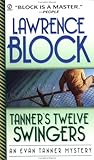 Tanner's Twelve Swingers by Lawrence Block
My rating: 4 of 5 stars
Continuing my revisit of Lawrence Block’s Evan Tanner series, this is the third instalment, in which Tanner – lover and joiner of lost cause groups who also does jobs for a super-secret agency that mistakenly thinks he’s one of their agents – chooses his own mission just to get out of doing another mission. The Chief wants Tanner to stop the Colombian Agrarian Revolutionary Movement from overthrowing the current regime. Tanner – who happens to be a member of the Colombian Agrarian Revolutionary Movement – says he’s not available because he has a mission already lined up in Latvia (which at the time, you may remember from history class, was part of the USSR).
Tanner is not exactly lying – the truth is that he had drunkenly promised a lovelorn friend in the Latvian Army-In-Exile (of which Tanner is also a member) that he would go to Latvia to bring his gymnast girlfriend Sofija to America – which is impossible, but it gives him an excuse to not go to Colombia. Naturally, things get complicated as he makes his way to Latvia via various Eastern European contacts, all of whom have their own favours to ask. Before long, Tanner has to not only smuggle Sofija out of Latvia, but also her sister, her entire gymnast team, a subversive Yugoslavian author (and his manifesto), two rolls of microfilm, some documents written in Chinese, and a six-year-old girl named Minna who happens to be the heir to the Lithuanian throne (once the monarchy is restored, which is another cause Tanner supports).
This one takes a little while to get going, as Tanner spends the first few chapters establishing how he ended up on this mission in the first place, while also taking time to visit his infant son in Macedonia (see The Thief Who Couldn't Sleep for details). But the fun builds up as he finds himself saddled with one task after another. It’s also considerably lighter in tone than the previous book The Canceled Czech (well, I mean, come on, Nazis) and displays a lot of the humour I remember enjoying about this series. And while Minna now comes across to me as a little too mature for a six-year-old, she’s also rather likeable, and anyway, who reads these things for gritty realism?
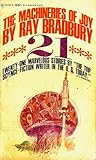 Machineries of Joy by Ray Bradbury
My rating: 4 of 5 stars
Back to Ray Bradbury with this 1964 collection of short stories that, if nothing else, shows how eclectic he was. In fact, it’s interesting how often Bradbury is described as an SF writer when really he was so much more than that. It’s perhaps more accurate to say he was a writer of the fantastic and slightly weird (I mean, even his SF was never that scientific, but it was decidedly imaginative and almost never dull). There’s certainly very little SF here, and even when there is, it’s more speculative than anything else.
The title track features two priests wondering what man’s upcoming exploration of space means for their vocation. "Boys! Raise Giant Mushrooms in Your Cellar" hints at an alien invasion, but could also be a metaphor for drug addiction. “The Chicago Abyss” and “The Vacation” dip into post-apocalyptic dystopian territory. Yet other stories involve Mexican funerary customs, talking ventriloquist dummies, an homage to Ray Harryhausen and a competition to see who can exit an Irish movie house the fastest before the national anthem starts playing.
As always, some are better than others, but Bradbury’s writing style almost always captivates and mesmerises me – and he certainly does here. Sometimes it really is more about how you tell it.
View all my reviews
Heavy machineries,
This is dF
Enchantress Of Venus by Leigh BrackettMy rating: 2 of 5 stars
Continuing my exploration of the works of Leigh Brackett, this is the second of her Eric John Stark novellas, which I would have read before the third one, Black Amazon of Mars, if I’d realised at the time there was a copy of it on Project Gutenberg, but then these things weren’t really written with an ongoing story arc in mind. Anyway, this one opens with Stark – the Tarzan/John Carter hybrid who makes a living as a mercenary – on Venus, sailing along the Red Sea to the town of Shuruun, to find his missing friend Helvi.
True to form, Stark finds himself in trouble by the end of Chapter 1 after inadvertently making an enemy of the ship’s captain Malthor. He makes it to Shuruun, a pirate town which is run by the Lhari, a cruel, power-hungry family. Stark learns that the Lhari are enslaving people to search the ruins of an ancient temple whose ancient god-like builders had supposedly developed a secret technology that can create new life and transform existing people into god-like monsters. The Lhari want that technology. Stark thinks that might be a bad idea.
And so on. As usual, Brackett writes this stuff well above average, and also as usual, the love-interest angles are the least-believable elements in the story. It’s good for what it is, but I felt this one was a little light on plot and a little slow in the second act, compared to the first and third Stark tales. Still, as planetary romance goes, it’s alright.
Tanner's Twelve Swingers by Lawrence BlockMy rating: 4 of 5 stars
Continuing my revisit of Lawrence Block’s Evan Tanner series, this is the third instalment, in which Tanner – lover and joiner of lost cause groups who also does jobs for a super-secret agency that mistakenly thinks he’s one of their agents – chooses his own mission just to get out of doing another mission. The Chief wants Tanner to stop the Colombian Agrarian Revolutionary Movement from overthrowing the current regime. Tanner – who happens to be a member of the Colombian Agrarian Revolutionary Movement – says he’s not available because he has a mission already lined up in Latvia (which at the time, you may remember from history class, was part of the USSR).
Tanner is not exactly lying – the truth is that he had drunkenly promised a lovelorn friend in the Latvian Army-In-Exile (of which Tanner is also a member) that he would go to Latvia to bring his gymnast girlfriend Sofija to America – which is impossible, but it gives him an excuse to not go to Colombia. Naturally, things get complicated as he makes his way to Latvia via various Eastern European contacts, all of whom have their own favours to ask. Before long, Tanner has to not only smuggle Sofija out of Latvia, but also her sister, her entire gymnast team, a subversive Yugoslavian author (and his manifesto), two rolls of microfilm, some documents written in Chinese, and a six-year-old girl named Minna who happens to be the heir to the Lithuanian throne (once the monarchy is restored, which is another cause Tanner supports).
This one takes a little while to get going, as Tanner spends the first few chapters establishing how he ended up on this mission in the first place, while also taking time to visit his infant son in Macedonia (see The Thief Who Couldn't Sleep for details). But the fun builds up as he finds himself saddled with one task after another. It’s also considerably lighter in tone than the previous book The Canceled Czech (well, I mean, come on, Nazis) and displays a lot of the humour I remember enjoying about this series. And while Minna now comes across to me as a little too mature for a six-year-old, she’s also rather likeable, and anyway, who reads these things for gritty realism?
Machineries of Joy by Ray BradburyMy rating: 4 of 5 stars
Back to Ray Bradbury with this 1964 collection of short stories that, if nothing else, shows how eclectic he was. In fact, it’s interesting how often Bradbury is described as an SF writer when really he was so much more than that. It’s perhaps more accurate to say he was a writer of the fantastic and slightly weird (I mean, even his SF was never that scientific, but it was decidedly imaginative and almost never dull). There’s certainly very little SF here, and even when there is, it’s more speculative than anything else.
The title track features two priests wondering what man’s upcoming exploration of space means for their vocation. "Boys! Raise Giant Mushrooms in Your Cellar" hints at an alien invasion, but could also be a metaphor for drug addiction. “The Chicago Abyss” and “The Vacation” dip into post-apocalyptic dystopian territory. Yet other stories involve Mexican funerary customs, talking ventriloquist dummies, an homage to Ray Harryhausen and a competition to see who can exit an Irish movie house the fastest before the national anthem starts playing.
As always, some are better than others, but Bradbury’s writing style almost always captivates and mesmerises me – and he certainly does here. Sometimes it really is more about how you tell it.
View all my reviews
Heavy machineries,
This is dF
