![[personal profile]](https://www.dreamwidth.org/img/silk/identity/user.png)
50% boost via a class assignment. It counts!
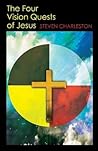 The Four Vision Quests of Jesus by Steven Charleston
My rating: 5 of 5 stars
One good thing about taking classes is that it leads you to reading books it might not otherwise have occurred to you to try if you just saw it sitting on a bookstore shelf. Such is the case with this, in which Steven Charleston (a Choctaw Native American and an ordained Episcopal priest) writes about how, as a young man – faced with the possibility of having to choose between his Christian faith and his Choctaw heritage – sought a way to reconcile them. He found the answer in the traditional Native practice of the vision quest.
Put simply, a vision quest is a ritual in which a person goes through a physical ordeal of purification and fasting in order to receive spiritual advice in the form of a vision that results in a transformation. Charleston’s own vision quest led him to realise that (1) Jesus’ 40 days in the desert was a vision quest itself, (2) four stories in Matthew’s gospel can be interpreted from a Native American POV as vision quests, and (3) the incarnation of Jesus was God’s own vision quest to become a transformative reality for his children. Charleston’s thesis is that both Native American and Christian traditions invite us to the dynamic inner experience of relating with God and growing in our humanity.
I’m oversimplifying it due to lack of space – it’s a complex concept even before you get into the theological comparisons between Christianity and the Native American concept of God. But it’s a fascinating read – not only for the detailed descriptions of Native American culture and spirituality (as well as the suffering they endured at the hands of white colonialists), but also how these dovetail with and/or map onto the overall Gospel message and its underlying theology. As with all things theological, there are points of contention and plenty of room for misunderstandings of what Charleston is saying here – and obviously, for people of certain political persuasions, the whole book is probably woke heresy. For me, I got a lot out of it, both intellectually and spiritually.
 The Telling by Ursula K. Le Guin
My rating: 4 of 5 stars
Published in 2000, this is the eighth and last instalment of Ursula K. Le Guin’s Hainish Cycle novels, in which a young woman from Terra named Sutty is sent to the planet Aka on her first mission as an Observer for the Ekumen (the alliance of Hainish worlds). Aka’s corporate government has ambitions of its own to become a technological superpower, join the Ekumen and explore interstellar space. The thing is, the Ekumen believes you can only really know a society from its history and its cultural roots, but the Corporation has outlawed and suppressed all of Aka’s traditional customs and beliefs (to include its original language) in fear that these will prevent them from achieving their vision.
Sutty – who specialises in language and literature – is assigned by the Ekumen to learn about pre-Corporate Akan culture and history, but isn’t allowed outside of the capital of Dovra City where that info has been erased. She also finds it hard to be objective about the Corporation, as she grew up on Terra when it had become an oppressive and brutal religious theocracy. When the Corporation unexpectedly approves an Ekumen trip to the old provincial town Okzat-Ozkat, Sutty’s boss asks her to go, suspecting that knowledge of the old ways may still exist there in some form. Sutty reluctantly agrees to make the trip and try to uncover details of Aka’s secret history and culture – particularly its traditions of storytelling (a.k.a. "the Telling").
Reportedly, Le Guin used China’s Great Leap Forward and the Cultural Revolution as a framework for Aka’s background, though of course it’s far more than just a rehash of that particular history. In any case, I found Sutty’s exploration of Akan culture compelling, not least because it illustrates not only why cultural history matters, but also how “banned” ideas and practices can still thrive in oppressive societies when they’re embedded in daily life to the point that it’s hard for authorities to pinpoint it as an illegal activity. Also interesting is Sutty’s struggle to maintain objectivity (given her own experience of religious and sexual oppression on Terra), especially as she immerses herself deeper into Okzat-Ozkat's "forbidden" culture under the nose of a govt Monitor assigned to keep an eye on her. Some readers may find it too slow, but I found myself engrossed by it. It may not be her best novel, but it’s possibly one of her more underrated.
View all my reviews
Stories I tell,
This is dF
The Four Vision Quests of Jesus by Steven CharlestonMy rating: 5 of 5 stars
One good thing about taking classes is that it leads you to reading books it might not otherwise have occurred to you to try if you just saw it sitting on a bookstore shelf. Such is the case with this, in which Steven Charleston (a Choctaw Native American and an ordained Episcopal priest) writes about how, as a young man – faced with the possibility of having to choose between his Christian faith and his Choctaw heritage – sought a way to reconcile them. He found the answer in the traditional Native practice of the vision quest.
Put simply, a vision quest is a ritual in which a person goes through a physical ordeal of purification and fasting in order to receive spiritual advice in the form of a vision that results in a transformation. Charleston’s own vision quest led him to realise that (1) Jesus’ 40 days in the desert was a vision quest itself, (2) four stories in Matthew’s gospel can be interpreted from a Native American POV as vision quests, and (3) the incarnation of Jesus was God’s own vision quest to become a transformative reality for his children. Charleston’s thesis is that both Native American and Christian traditions invite us to the dynamic inner experience of relating with God and growing in our humanity.
I’m oversimplifying it due to lack of space – it’s a complex concept even before you get into the theological comparisons between Christianity and the Native American concept of God. But it’s a fascinating read – not only for the detailed descriptions of Native American culture and spirituality (as well as the suffering they endured at the hands of white colonialists), but also how these dovetail with and/or map onto the overall Gospel message and its underlying theology. As with all things theological, there are points of contention and plenty of room for misunderstandings of what Charleston is saying here – and obviously, for people of certain political persuasions, the whole book is probably woke heresy. For me, I got a lot out of it, both intellectually and spiritually.
The Telling by Ursula K. Le GuinMy rating: 4 of 5 stars
Published in 2000, this is the eighth and last instalment of Ursula K. Le Guin’s Hainish Cycle novels, in which a young woman from Terra named Sutty is sent to the planet Aka on her first mission as an Observer for the Ekumen (the alliance of Hainish worlds). Aka’s corporate government has ambitions of its own to become a technological superpower, join the Ekumen and explore interstellar space. The thing is, the Ekumen believes you can only really know a society from its history and its cultural roots, but the Corporation has outlawed and suppressed all of Aka’s traditional customs and beliefs (to include its original language) in fear that these will prevent them from achieving their vision.
Sutty – who specialises in language and literature – is assigned by the Ekumen to learn about pre-Corporate Akan culture and history, but isn’t allowed outside of the capital of Dovra City where that info has been erased. She also finds it hard to be objective about the Corporation, as she grew up on Terra when it had become an oppressive and brutal religious theocracy. When the Corporation unexpectedly approves an Ekumen trip to the old provincial town Okzat-Ozkat, Sutty’s boss asks her to go, suspecting that knowledge of the old ways may still exist there in some form. Sutty reluctantly agrees to make the trip and try to uncover details of Aka’s secret history and culture – particularly its traditions of storytelling (a.k.a. "the Telling").
Reportedly, Le Guin used China’s Great Leap Forward and the Cultural Revolution as a framework for Aka’s background, though of course it’s far more than just a rehash of that particular history. In any case, I found Sutty’s exploration of Akan culture compelling, not least because it illustrates not only why cultural history matters, but also how “banned” ideas and practices can still thrive in oppressive societies when they’re embedded in daily life to the point that it’s hard for authorities to pinpoint it as an illegal activity. Also interesting is Sutty’s struggle to maintain objectivity (given her own experience of religious and sexual oppression on Terra), especially as she immerses herself deeper into Okzat-Ozkat's "forbidden" culture under the nose of a govt Monitor assigned to keep an eye on her. Some readers may find it too slow, but I found myself engrossed by it. It may not be her best novel, but it’s possibly one of her more underrated.
View all my reviews
Stories I tell,
This is dF
